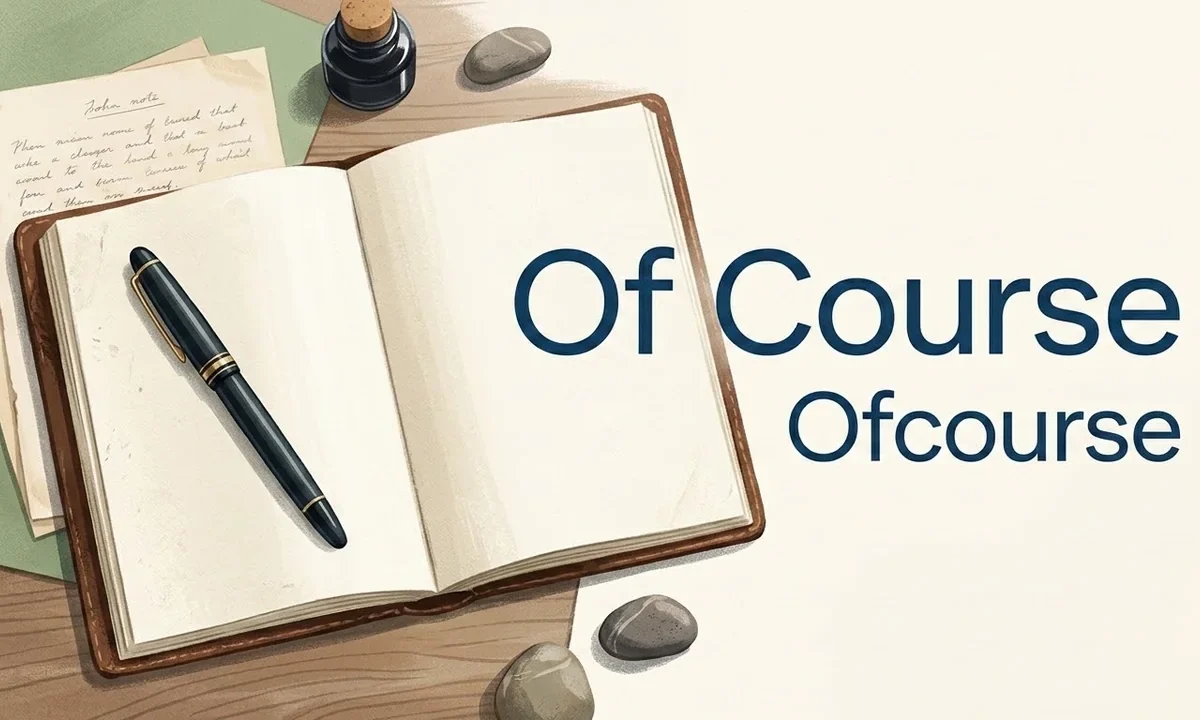
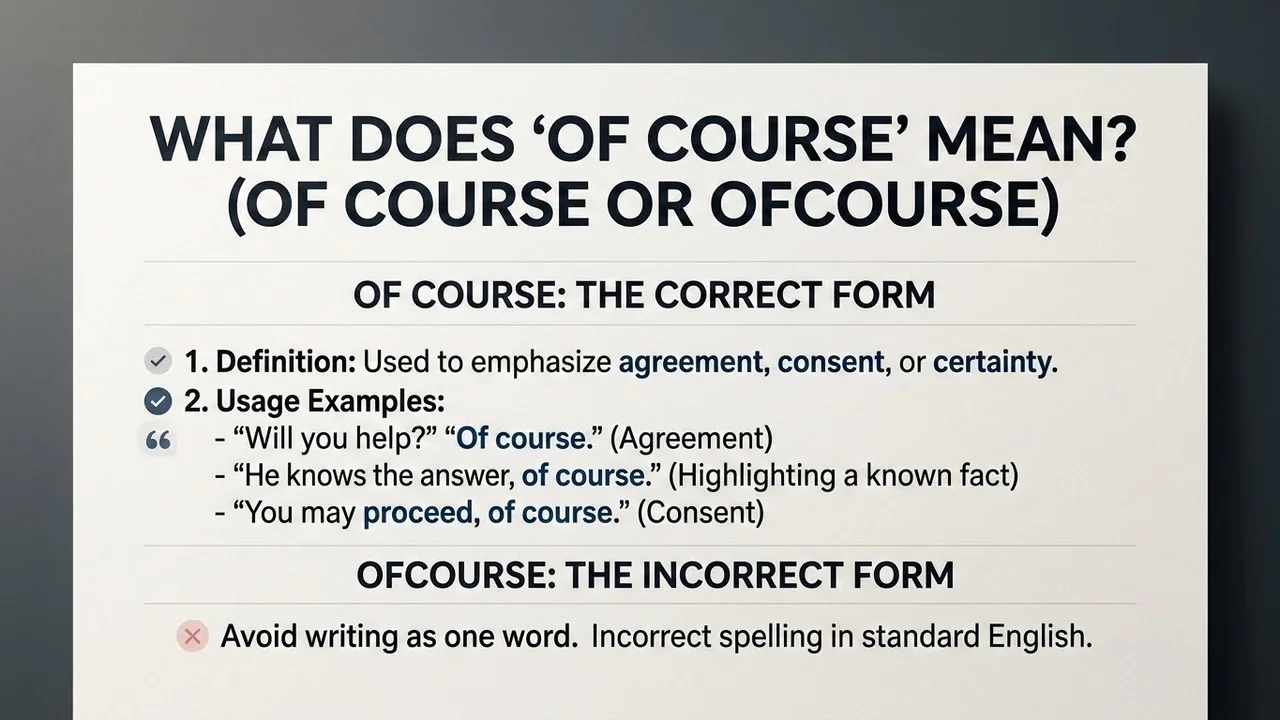
Of Course or Ofcourse is answered directly: Of Course is the correct spelling. It is used to show agreement or confirmation. The reason for the mix-up is the silent space between the words. This space can cause confusion for many people.
People mix up Of Course and Ofcourse because of the silent space between the words. This can make them sound like one word. The letter combination is the cause of the mix-up. Readers will learn the correct spelling and usage after this guide. They will use Of Course correctly always.
Quick Answer
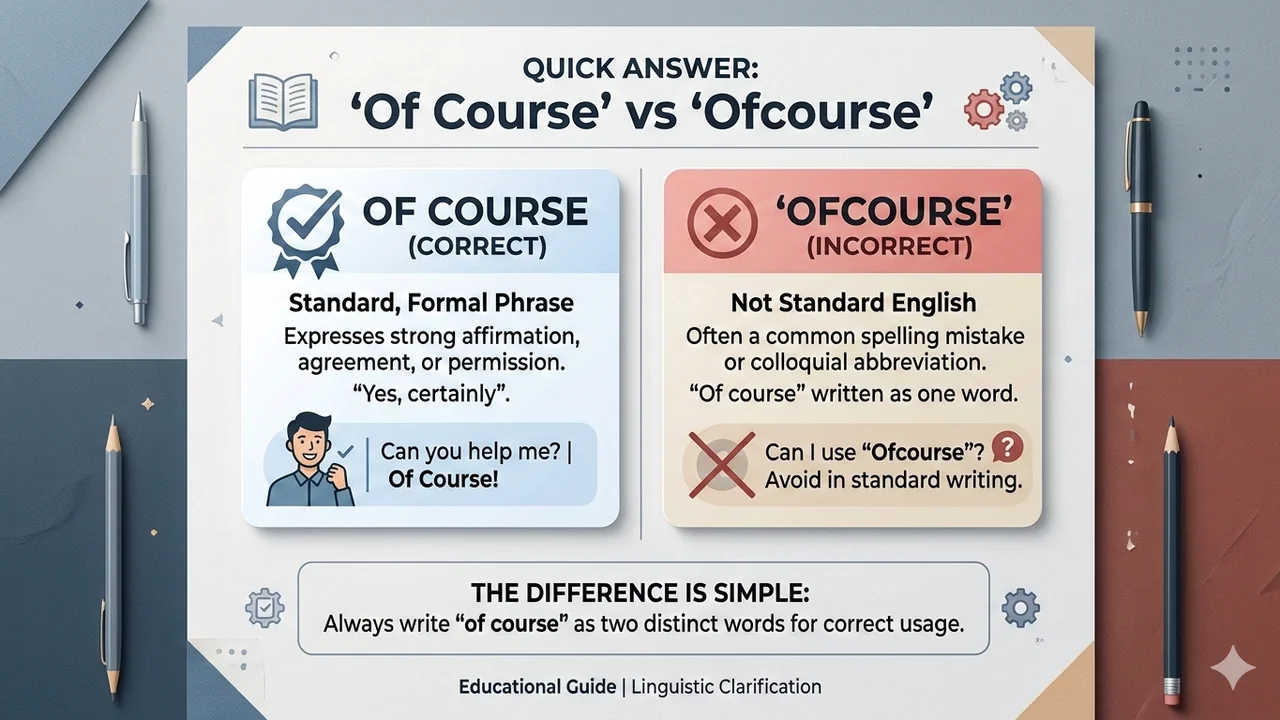
The correct spelling is Of Course, not Ofcourse. This is because Of Course is a phrase consisting of two separate words. It is used to express agreement or confirmation.
What Does Of Course Mean?
This section explores the meaning of Of Course and its usage. It covers examples and the correctness of the phrase.
Read Also: Cocoon or Cacoon? Which Spelling Is Correct? (Complete Grammar Guide)
The Origin of Course
The phrase of course comes from Latin. It means naturally or obviously. Of course is two words. It has been used in English since the 17th century. The phrase is used to show agreement or confirmation. For example, someone asks if you want coffee, and you say of course to show you really want it.

Of Course in Historical Context
The phrase of course has been used for centuries. It originated in the 17th century. Notable examples are found in literature and speeches. Of course was used by famous authors like Jane Austen. It is still used today to express agreement or confirmation.
Read Also: Take the scenic route

Examples of “Of Course” in Sentences
Of Course is used to show agreement. For example: I will attend the meeting, of course. See Merriam-Webster grammar and usage guide for more.

Is “Ofcourse” a Real Word?
Ofcourse is not a word in standard dictionaries. It looks right due to the silent space between Of and Course. See Cambridge Dictionary English grammar guide for more.

Of Course in American and British English
Both American and British English use Of Course. The phrase is spelled the same in both varieties. It is used to express agreement or confirmation in both.
| Aspect | American English | British English |
|---|---|---|
| Preferred Spelling | Of Course | Of Course |
| Related Forms | None | None |
| Pronunciation | OF KORS | OF KORS |
| Example Sentence | I will attend, of course. | I will attend, of course. |
Read Also: Everyday architecture, seen anew
Side-by-Side Comparison of Course and Ofcourse
| Word | Meaning | Correctness |
|---|---|---|
| of course | aturally, certainly | ✓ Correct |
| ofcourse | No meaning | ✗ Incorrect |
Regional Variations in Usage
American and British English spell it the same way: of course. It is used similarly in both varieties. The phrase is common in formal and informal writing. Of course is used to show agreement or confirmation. It is also used to make a statement stronger. The spelling ofcourse is incorrect.
Mini Quiz: Of Course or Ofcourse?
This section tests the understanding of the correct spelling and usage of Of Course. It covers various scenarios and contexts.
Which spelling is correct?
The correct spelling is Of Course, with a space between the words.
Fill in the blank:
I will attend the meeting, _______. The answer is of course.
True or False?
Ofcourse is a correct spelling. The answer is False.
Which one should you avoid in professional writing?
Avoid using Ofcourse in professional writing.
Complete the sentence:
I will help you, _______. The answer is of course.
Which phrase is grammatically correct?
The phrase “Of Course I will attend” is grammatically correct.
Quick Check!
Check for a space between Of and Course.
Common Reasons Behind the Mistake
The mistake occurs due to the silent space between Of and Course.
Why People Confuse Of Course and Ofcourse
People confuse of course and ofcourse due to linguistic factors. The phrase is often spoken quickly. This leads to a loss of the space between the words. Cognitive factors also play a role. Autocorrect can introduce errors. Additionally, the similarity in spelling causes confusion. It is a known issue.
Teaching Of Course to Non-Native Speakers
When teaching of course, explain it as a polite way to agree or show willingness. Use examples like: I’d love to help, of course. Emphasize it’s two words, not one. Common errors include writing it as ofcourse. This is a key point.
Memory Tricks for Non-Native Speakers
Non-native speakers can remember of course by thinking of a course in school. It has two words and two meanings: a class and a path to follow. This helps to keep the words separate. Another trick is to read it out loud.
Teaching Of Course to Children
When teaching of course, explain it’s two words. Use it in sentences like “I’ll help, of course.” Emphasize the space between the words. Parents can point out correct usage in books and media. Educators can create exercises to practice using of course in context. This helps children understand its meaning and use it correctly.
“Of Course” at the Beginning of a Sentence
Of Course can be used at the beginning of a sentence for emphasis.
“Of Course” in the Middle of a Sentence
Of Course is often used in the middle of a sentence to show agreement.
“Of Course” as a Complete Response
Of Course can be used as a complete response to a question.
Of Course in Different Contexts
In emails, of course shows agreement. It is also used in news articles to mean naturally. In conversation, it can express politeness. For example, someone might say, “I’ll help, of course.” Or, “Of course. I’ll be there.” It can also mean obviously, as in, “It’s raining, of course.”.
Of Course in Informal Conversations
In everyday conversations, of course is used to show agreement or confirmation. It’s often used with friends or family. For example, a friend asks to borrow something and you say “of course” to agree. You can also use it to express willingness to help. In discussions, it softens a statement, like saying “I’m busy. However, of course I’ll help you.” It’s a polite way. To respond to requests or questions from people you know well.
Of Course in Emails and Newsletters
In emails and newsletters, of course is used to show politeness. It makes the tone friendly and professional. We use it to agree or accept something. For example, a reply to an invitation might be: “I would love to attend. Of course.” It can also soften a refusal: “Thank you for thinking of me. Of course I’m flattered.” Using of course in this way helps to build good relationships with readers.
Avoiding Ofcourse in Professional Emails
In professional emails, of course is the correct spelling. It means naturally or obviously. Use it to show agreement or confirmation. For example, “I will attend the meeting, of course.” or “Please let me know if you need anything. Of course I can help.” This helps to sound polite and professional.
Why It Is Not a Compound Word
Of Course is not a compound word because it consists of two separate words.
Similar Two-Word Expressions
Other two-word expressions like Of Course include In Fact and On Time.
| Expression | Meaning |
|---|---|
| In Fact | Actually |
| On Time | Punctually |
| Of Course | Agreement |
| As Well | Also |
| In Addition | Moreover |
Comparing Of Course with Similar Phrases
Of course is used to show agreement. It can be paired with not for contrast. We say of course not to refuse something. In contrast, of course yes confirms agreement. These phrases are used in different situations to convey varying levels of agreement or disagreement. For example, “I’m going to the party, of course” shows enthusiasm, while “of course not” declines an offer.
Synonyms for Of Course
Certainly and naturally are good alternatives. We can use them in sentences like:
Why Bloggers Should Avoid “Ofcourse”
Bloggers should avoid Ofcourse because it is not a standard word.
Of Course in Formal Writing
In formal writing, of course is used to show agreement or confirmation. It is appropriate in academic and professional contexts. Of course is two words. It adds a touch of politeness to sentences. For example, it can be used to express agreement or acknowledge something obvious.
Of Course in Formal Academic Writing
In formal academic writing, of course is used to convey certainty and politeness. It acknowledges the reader’s expectations. Of course is written as two words. It is used in research papers and essays to show agreement. For example, “The data clearly shows the trend, of course, supporting our hypothesis.”
Of Course in Specialized Fields
In law, of course precedes a statement of fact. It is used in medicine to acknowledge a patient’s concern. In technology, of course confirms a basic principle. For example, a lawyer might say: the contract is binding, of course. A doctor could say: you will need rest, of course. A technician might say: the software requires updates, of course.
Use Grammar Tools
Grammar tools can help identify the correct spelling of Of Course.
Memory Tricks for Correct Spelling
To remember of course is two words, try saying it in a sentence. Notice the space between of and course. You can also think of a golf course, which is one word. Of course has two words, like two separate signs. It is a common phrase.
Copying Informal Internet Usage
Avoid copying informal internet usage, which may include incorrect spellings.
Common Mistakes in Social Media
People often misspell of course as ofcourse online. This error happens in comments and posts. It is easy to fix. Just add a space between of and course. For example, of course is correct in: I will attend, of course. It is a simple correction.
Using Of Course in Social Media Posts
When writing social media posts, use of course to show agreement or confirmation. It adds a polite tone. For example, “I love this new cafe, of course I’ll meet you there!” or “This sale is amazing. Of course I’m buying it!” Always write it as two words.
Frequently Asked Questions
How do you spell of course?
Correctly spelling of course requires two words. It is a phrase consisting of two separate words.
What is the meaning of course?
Of course means certainly or definitely. It is used to show agreement or confirmation.
Is of course formal or informal?
Of course can be both formal and informal. It depends on the context in which it is used.
Can I use of course in academic writing?
Yes, of course can be used in academic writing. It is suitable for formal and informal academic contexts.
Does Google recognize ofcourse?
Google does not recognize ofcourse as correct. It suggests the correct spelling is of course.
Conclusion
The correct answer is Of Course or Ofcourse, where the correct choice is Of Course with a space. The rule is to use two words always. This makes it clear and easy. The space is very important here.
To remember the correct spelling, use a memory trick with Of Course or Ofcourse, thinking of each word separately. This helps in writing and speech. It builds confidence and clarity. The trick is simple and effective always.