
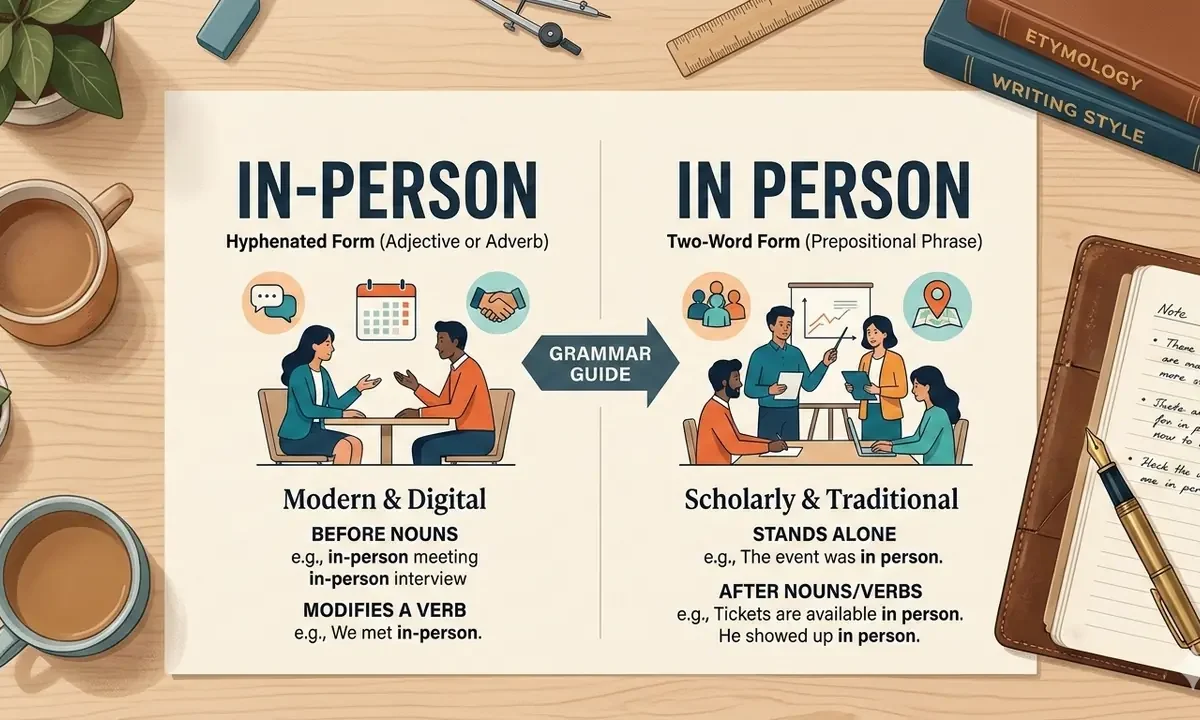
In-Person vs In Person is answered directly: in-person is correct when used as a compound adjective. People mix them up due to the hyphen, which indicates a compound adjective. This guide will help readers understand the difference and use the correct form confidently. The correct usage is important for clear communication.
The reason people mix up in-person and in person is the letter and sound involved. The hyphen makes a big difference in meaning and usage. After this guide, readers will be able to identify and use the correct form in sentences. The guide will cover the meaning and usage of in-person and in person clearly.
Quick Answer
The correct form is in-person when used as a compound adjective, and in person as an adverbial phrase. This is because in-person describes a noun, while in person describes a verb.
| Correct | Incorrect |
|---|---|
| In-person meeting | In person meeting |
| In person attendance | In-person attendance |
Origin of the Confusion
The confusion between in-person and in person stems from their similar meanings. Historically, in person was used to mean attending an event physically. The hyphenated in-person emerged to describe meetings or interactions that occur face-to-face. This subtle distinction has led to confusion over the years. Both forms are often used in similar contexts, making it difficult to determine which is correct.
Read Also: Cocoon or Cacoon? Which Spelling Is Correct? (Complete Grammar Guide)

What Is the Difference Between In-Person and In Person?
In-person is a compound adjective used to describe a noun. Meanwhile, in person is an adverbial phrase used to describe a verb. This difference is crucial in understanding the correct usage of each form.

Understanding In Person as an Adverbial Phrase
In person is used to describe a verb, indicating that something is done directly or physically present. This understanding is essential in using the correct form in sentences.
Read Also: Take the scenic route

Why People Confuse In-Person and In Person
The confusion between in-person and in person often stems from their similar pronunciation. Many people are also unclear about the hyphenation rule, which dictates when to use a hyphen between words. This lack of understanding leads to confusion in everyday writing. In-person is used as an adjective, while in person is used as an adverb. The hyphen makes a big difference in meaning. See Merriam-Webster grammar and usage guide for more.

The Grammar Rule Behind Hyphenation
Compound adjectives like in-person use hyphens. This rule applies before nouns. It prevents confusion and clarifies meaning. For example, in-person meetings are face-to-face. Other compound adjectives follow this rule, such as well-known and full-time. They use hyphens to form a single concept. See Cambridge Dictionary English grammar guide for more.

In-Person vs In Person in Formal Writing
In formal writing, in-person is used as a compound adjective. It modifies a noun, like a meeting. In person is used for physical presence. For example, one attends a meeting in person. Formal writing requires precision with these phrases to convey the intended meaning clearly and accurately.
Read Also: Everyday architecture, seen anew

In-Person vs In Person in Academic Writing
In academic writing, in-person refers to interactions that occur face-to-face. It is often used in research papers to describe interviews or meetings. In contrast, in person is used to describe someone who is present. For example, a researcher may conduct in-person interviews, while a student may attend a lecture in person. This distinction is important to maintain clarity in academic writing.
American and British English
Both American and British English use in-person as a compound adjective and in person as an adverbial phrase. There is no difference in usage between the two varieties.
| Aspect | American English | British English |
|---|---|---|
| Compound Adjective | In-person | In-person |
| Adverbial Phrase | In person | In person |
| Example Sentence | I attended the in-person meeting. | I attended the meeting |
| Pronunciation | IN-PER-son | IN-PER-son |
| Usage | Before a noun | Before a noun |
| Alternative | Face-to-face | Face-to-face |
| Common Error | In person meeting | In person meeting |
Read Also: Making space for your next idea
In-Person vs In Person in Different Contexts
In emails, in-person is often used to clarify meetings. It’s also common in news headlines for events. In social media posts, in person appears more frequently, while formal speeches usually use in-person for meetings and interviews. For example, a company might send an email saying “We will discuss this in-person tomorrow.”
In-Person vs In Person in Informal Writing
In informal writing, in-person and in person have different uses. In-person is an adjective, describing something that happens face-to-face. It is used before a noun. In person is an adverbial phrase, describing how something is done. It is used after a verb. For example, “I prefer in-person meetings” and “I will attend the meeting in person“. In text messages, social media posts, and blogs, in-person is often used to describe events or meetings. Meanwhile,
Read Also: Notes from the mountain road
In-Person vs In Person in Technical Writing
In technical writing, in-person refers to face-to-face interactions. It is used in user manuals to describe training sessions. In person is used in instructional guides to mean attending an event. Research papers use in-person for interviews and
- User manuals: “Attend an in-person training session.”
- Instructional guides: “Please sign the document
- Research papers: “We conducted in-person interviews with experts.”
Everyday Examples in Social Media
Social media posts often use in-person and in person differently. We meet in person at the conference. The training is in-person, not online. I prefer in-person meetings to discuss details. Let’s schedule a meeting in person to finalize plans.
In-Person vs In Person: Side-by-Side Comparison
Understanding the difference between in-person and in person is crucial in using the correct form in sentences. This comparison will help readers identify the correct usage of each form.
Common Mistakes in Everyday Conversation
People often confuse in-person and in person. For example, they say “I met him in person at the store” when they mean an informal meeting. To correct this, use in person for informal meetings and in-person for formal events, like conferences. Correct usage sounds more professional.
Common Mistakes in News Headlines
News headlines often misuse in-person and in person. In-person refers to activities that need physical presence. For example, interviews are often conducted in-person. In contrast, in person means to appear personally. A judge may appear in person in court. Using them correctly is crucial for clear communication.
Memory Trick
A memory trick to remember the correct form is to use. in-person when describing a noun and in person when describing a verb. This trick will help readers use the correct form confidently.
| Form | Usage |
|---|---|
| In-person | Before a noun |
| In person | After a verb |
| In-person | Describing a meeting |
| In person | Describing attendance |
| In-person | Formal setting |
| In person | Informal setting |
| In-person | Physical presence |
Why Consistency Matters
Consistency is key to clear writing. Using in-person and in person correctly matters. It affects how readers see your work. Inconsistent usage can confuse readers. It can also make your writing seem less credible. For example, a sentence like “The meeting will be held in-person” is clear. But switching between the two forms can be confusing. Consistency helps to avoid this problem and makes your writing more effective.
Mini Quiz: In-Person vs In Person
This quiz will test readers’ understanding of the difference between in-person and in person. It will help readers identify the correct usage of each form in sentences.
Synonyms for In-Person and In Person
In-person and in person have similar meanings. They can be replaced with face-to-face or personally.
- Face-to-face is used for meetings.
- Personally is used for actions.
- Directly is used for communication.
Fill in the Blank
Fill in the blank with the correct form: I attended the ______ meeting. Answer: in-person.
Tips for Non-Native English Speakers
Non-native English speakers can master in-person and in person by learning their meanings. In-person refers to face-to-face interactions. It is often used as an adjective. In person means physically present. Practice using them in sentences to improve your English skills.
Tips for Using In-Person and In Person in Emails
When writing emails, use in-person to describe meetings or interactions that occur face-to-face. In formal emails, write “We will conduct the interview in-person.” In informal emails, “Let’s meet in-person to discuss” is correct. For phrases like “in person” meaning physically present. Use “I will attend the event in person.” This distinction. Helps you communicate clearly in both formal and informal email settings.
Avoiding Common Mistakes in Everyday Emails
When writing emails, people often confuse in-person and in person. To use them correctly, remember that in-person refers to face-to-face interactions. For example, in-person meetings are held face-to-face. On the other hand, in person means to appear physically. Correct usage is key to clear communication.
Spot the Error
Spot the error in the sentence: I attended the meeting
Choose the Correct Word
Choose the correct word: I attended the meeting in-person or in person. Answer: In person.
Quiz 1: Which One Describes a Noun?
Which one describes a noun: in-person or in person? Answer: In-person.
Real-World Applications of In-Person and In Person
In education, in-person classes are preferred. They provide face-to-face interaction. Students learn better this way. For example, a teacher can give immediate feedback in an in-person setting. In business, meetings are often held in person. This allows for discussion and negotiation. In healthcare, patients are treated in person by doctors. This ensures proper care and attention.
Quiz 2: Fill in the Blank
Fill in the blank: I attended the ______ training session. Answer: in-person.
Quiz 3: Quick Choice
Choose the correct form: in-person or in person meeting. Answer: In-person.
Quiz 4: Fill in the Blank
Fill in the blank: I met the client ______. Answer: in person.
Quiz 5: True or False
True or false: In-person is used to describe a verb. Answer: False.
Quiz 6: Fill in the Blank
Fill in the blank: I attended the ______ conference. Answer: in-person.
Quiz 7: Spot the Correct Sentence
Spot the correct sentence: I attended the meeting in-person or in person. Answer: I attended the meeting in person.
Quiz 8: Fill in the Blank
Fill in the blank: I met the manager ______. Answer: in person.
Quiz 9: Grammar Check
Check the grammar: I attended the in-person meeting or in person meeting. Answer: I attended the in-person meeting.
Quiz 10: Fill in the Blank
Fill in the blank: I attended the ______ seminar. Answer: in-person.
Quiz 11: What Does It Describe?
What does in-person describe: a noun or a verb? Answer: A noun.
Quiz 12: Fill in the Blank
Fill in the blank: I met the team ______. Answer: in person.
Quiz 13: Choose the Right Form
Choose the right form: in-person or in person training. Answer: In-person.
Quiz 14: Quick Rule Test
Test the rule: In-person is used to describe a noun. Answer: True.
Quiz 15: Final Challenge
Choose the correct form: in-person or in person interview. Answer: In-person.
Frequently Asked Questions
Is in-person or in person used before a noun?
In-person is used before a noun, describing it. In-person describes the noun, indicating something is done face-to-face.
Can I use in-person after a verb?
In-person can be used after a verb, indicating the manner. It describes how something is done, which is face-to-face.
What is the correct spelling of in-person?
The correct spelling is in-person, with a hyphen. It is spelled with a hyphen, connecting the words.
Is in person one word or two words?
In person is two words, used as an adverb. It is used as an adverbial phrase, indicating the location.
How do I use in-person and in person in a sentence?
In-person and in person are used differently, depending context. In-person describes a noun, while in person is an adverbial phrase, indicating location or manner.
Conclusion
The verdict on In-Person vs In Person is clear and easy to understand now. The rule is simple to follow every time. It helps us choose the right form. We use one form to describe a noun and another form to describe a verb. This makes our writing clear.
Mastering In-Person vs In Person is easy with a memory trick. We use in-person before a noun and in person after a verb. This trick helps us use the correct form in sentences. It makes our writing clear and easy to read. It is a useful trick.