
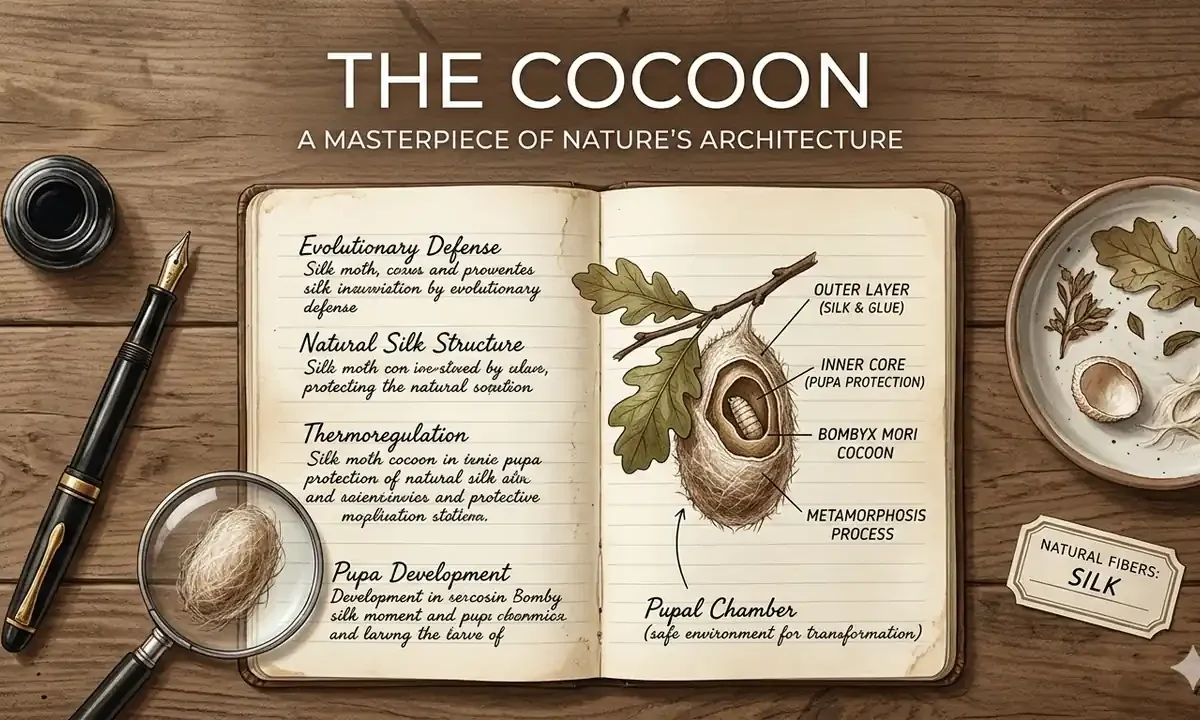
Cocoon or Cacoon is answered directly: Cocoon is the correct spelling. It refers to a protective covering. The word is often used in biology and ecology. Cocoon is used to describe a safe place for animals.
People mix up Cocoon and Cacoon due to the double “o” sound. The double “o” pattern causes the confusion. Readers will learn the correct usage of Cocoon in sentences. They will understand the word’s meaning and spelling clearly.
Quick Answer
The correct spelling is Cocoon. It has two “o”s for protection.
| Correct | Incorrect |
|---|---|
| Cocoon | Cacoon |
What Does Cocoon Mean
Cocoon means a protective covering, like a butterfly’s chrysalis.
Read Also: Of Course or Ofcourse: 2026 Guide

Origin of the Word Cocoon
The word cocoon comes from French. It is related to the word coque, meaning shell. The term refers to a protective covering.

Cocoon in Historical Context
The word cocoon originated from the French word cocon. It refers to a protective casing. In history, cocoon described silk pouches. The term has been used since the 15th century. It comes from the Old French word cocon, meaning shell.
Read Also: Take the scenic route

Understanding the Meaning of Cocoon
Cocoon is a noun that refers to a safe, enclosed space. See Merriam-Webster grammar and usage guide for more.

Cocoon in Different Contexts
In biology, a cocoon is a protective covering. It is also used in technology and everyday life. For example, a cocoon can refer to a safe space. People use cocoon to describe a cozy home. See Cambridge Dictionary English grammar guide for more.

Cocoon in Specialized Fields
In biology, a cocoon is a protective casing. It surrounds insects like butterflies. In psychology, people may feel in a cocoon when they are safe. Technology uses cocoon to describe protective codes. These fields use cocoon to mean safety and protection. This concept is useful.
Read Also: Everyday architecture, seen anew

Everyday Examples of Cocoon in Social Media
People use cocoon on social media to describe a cozy space. They post about wrapping up in a blanket like a cocoon. Others share photos of a cozy reading nook, calling it their cocoon. For example, they share pictures of a warm fireplace. This is a popular trend.
- I’m home alone and ready to cocoon myself in blankets.
- My favorite cocoon is a warm bath with a good book.
- Just made my bed a cocoon with pillows and blankets.
Cocoon in American and British English
Both American and British English use Cocoon with two “o”s.
| Aspect | American English | British English |
|---|---|---|
| Spelling | Cocoon | Cocoon |
| Pronunciation | kuh-KOON | kuh-KOON |
Regional Variations in Cocoon Usage
Both American and British English spell the word as cocoon. The pronunciation is KOH-koon. There are no regional variations in spelling.
Cocoon in News Headlines
The word cocoon appears in news headlines to describe protective measures. It is used in various contexts, such as environmental and social issues. News outlets use cocoon to convey a sense of safety and security. For example, a headline might read: “New technology helps cocoon endangered. Species from harm.” This usage shows the word’s relevance in formal journalism. Cocoon is a common metaphor in news headlines, illustrating its importance in descriptive language.
Consequences of Using Cacoon Instead of Cocoon
Using Cacoon instead of Cocoon can lead to confusion. It may affect how well you communicate. Your credibility may also suffer. Search engines may not understand Cacoon. This can hurt your online visibility.
Mini Quiz: Cocoon or Cacoon
This quiz covers Cocoon and Cacoon to help with spelling and meaning.
Quiz 1: Which spelling is correct?
The correct spelling is Cocoon, not Cacoon.
Quiz 2: Fill in the blank
The butterfly emerged from its Cocoon.
Quiz 3: What is wrong spelling?
Cacoon is the incorrect spelling of the word.
Quiz 4: Fill in the blank
The Cocoon protected the insect inside.
Quiz 5: Meaning check
Cocoon refers to a protective covering or enclosure.
Quiz 6: Fill in the blank
The Cocoon stage is crucial for transformation.
Quiz 7: True or False
True: Cocoon has two “o”s for correct spelling.
Quiz 8: Fill in the blank
The Cocoon is a safe space for growth.
Quiz 9: Choose the correct option
Correct option: Cocoon is the right spelling.
Quiz 10: Fill in the blank
The Cocoon provided protection from harm.
Quiz 11: Spelling test
Cocoon is spelled C-O-C-O-O-N.
Quiz 12: Fill in the blank
The Cocoon helped the insect transform.
Quiz 13: Quick understanding
Cocoon means a protective, enclosed space.
Memory Tricks for Remembering Cocoon
To remember Cocoon, try this trick: think of a coco nut in a cocoon. Another trick is to associate it with a butterfly coming out of its cocoon. You can also break it down into co-coon for easier recall. This helps with spelling.
Why Do People Write “Cacoon”?
People write Cacoon due to the similar sound of the double “o”.
Similar Sound Patterns
Similar sounds can cause confusion in spelling.
| Word | Use it for |
|---|---|
| Cocoon | Protective covering |
| Cacoon | Incorrect spelling |
Dictionary Recognition
Cocoon is recognized by dictionaries as the correct spelling.
What This Means for Writers
Writers should use Cocoon for correct spelling and meaning.
Trick 1: Think of Two O’s for Protection
Remember Cocoon has two “o”s for protection.
Mistake 3: Ignoring Spell Check Suggestions
Ignoring spell check can lead to Cacoon mistakes.
Memory Tricks for Learning the Correct Spelling
To remember cocoon, associate it with coconut, which has a similar sound. Another trick is to think of a butterfly in a cocoon, with two o‘s like two eyes. You can also break it down into co and coon, like a cozy room. These tricks help you recall the correct spelling.
Cocoon vs Similar-Sounding Words
| Word | Definition | Pronunciation | Example Sentence |
|---|---|---|---|
| Cocoon | A protective covering | kuh-KOON | The butterfly emerged from its cocoon. |
| Cacoon | Not a word | – | – |
| Canoe | A small boat | KAN-oo | We paddled across the lake in a canoe. |
Cocoon in Figurative Language
In figurative language, cocoon is a versatile term. It can be a metaphor for protection. We use it to describe a safe space. For example, a person might feel safe in their home. It can also be used in similes to describe something wrapped up tightly. Idioms like “in a cocoon” mean being isolated.
Cocoon in Creative Writing
The word cocoon is a powerful tool in creative writing. It can be used as a metaphor for transformation or protection. In literature, cocoon describes a safe space. For example, a character may feel safe in their home. A poet may write about a cocoon of love. Cocoon can also be used as a simile to describe something wrapped up tightly.
Synonyms for Cocoon
Words like chrysalis and shell convey similar meanings.
- Enclosure
- Sanctuary
- Nest
- Wrap
These words all relate to protection or covering.
Teaching Cocoon to Non-Native English Speakers
Non-native English speakers often find cocoon tricky. It refers to a protective covering. Teach the pronunciation as KOH-koon. Use it in sentences like: The butterfly emerged from its cocoon. This helps learners understand the word’s meaning and spelling. The word is useful in many contexts.
Teaching Cocoon to Children
To teach cocoon to children, use simple games. Show them a picture of a butterfly in a cocoon. Explain that it’s like a warm blanket. You can also play a spelling game with flashcards. Write cocoon on one card and cacoon on another. Ask them to pick the correct one. This helps them remember the correct spelling.
Cocoon in Educational Settings
In science classes, cocoon helps teach metamorphosis. It shows transformation. Students learn about life cycles. For example, a teacher might say: “The butterfly formed a cocoon to transform.” This concept is useful in lesson plans. It can be used to explain growth and change.
Common Mistakes in Formal Writing
Formal writing often requires precision. A common mistake is misspelling cocoon as Cacoon. This error occurs due to spelling confusion. Grammatical errors also happen, such as incorrect subject-verb agreement. Punctuation mistakes, like missing commas, can alter the sentence’s meaning. Accuracy is essential in formal writing.
Cocoon in Formal Speech and Presentations
In formal settings, Cocoon is the correct spelling. Using Cacoon can undermine credibility. Correct spelling matters in presentations and speeches. It shows attention to detail and care for one’s message. For example, saying “The butterfly emerged from its Cocoon” sounds professional.
Cocoon in Technical Writing
In technical writing, correct spelling is crucial. Cocoon is used in biology to describe a protective casing. It is used to describe the pupal stage of insects. For example, a butterfly forms a cocoon before emerging. This term is also used in other technical fields to describe a protective covering.
Cocoon in Academic Research
In academic research, cocoon refers to a protective covering. It is used in biology to describe insect metamorphosis. Researchers also use cocoon in psychology and sociology to study social isolation. For example, a study might explore how people cocoon themselves from others.
Common Mistakes in Email Correspondence
When writing emails, people often misspell cocoon as Cacoon. This mistake can make emails look unprofessional. For example, cocoon is correctly used in: I’m feeling safe in my cocoon of blankets. Incorrect usage includes: The butterfly emerged from its Cacoon. Corrected sentences use cocoon correctly, like: The insect spun a cocoon around itself.
Why Cacoon is Not a Recognized Word
Cacoon is not found in dictionaries. It has no definition. Cacoon is not used in sentences. The correct word is Cocoon.
The Impact of Using Cacoon on Search Engine Optimization
Using cacoon instead of cocoon can harm search engine optimization. It may lower website ranking and visibility. Search engines prefer correct spellings. Incorrect spellings can lead to fewer visitors. This affects website traffic and credibility.
The Impact of Cacoon on Branding and Marketing
Using Cacoon instead of Cocoon can harm a company’s image. It may seem like a small mistake, but it can make a company appear unprofessional. Customers may question the company’s attention to detail. This can lead to a loss of trust and credibility, affecting the company’s online presence and reputation.
Frequently Asked Questions
Is cacoon a real word?
Generally speaking, cacoon is not recognized. It is considered a misspelling of cocoon. The term cocoon refers to a protective casing.
What is the correct spelling of cocoon?
Correctly spelled, cocoon has two o’s. This spelling applies universally, including in American and British English. The double o’s are essential for the word’s meaning.
Why do people spell cocoon as cacoon?
Often, the mistake occurs due to similar sounds. The words may sound alike, leading to confusion and incorrect spelling. Awareness of the correct spelling helps prevent this error.
Is cocoon used outside biology?
Beyond biology, cocoon is used metaphorically. It describes a protective or nurturing environment, such as a cocoon of comfort or a cocoon of silence. This usage is common in literature and everyday language.
Can using ‘cacoon’ hurt SEO?
Using the incorrect spelling can negatively impact search engine optimization. Search engines may not recognize the misspelling, potentially reducing the visibility of the content. Correct spelling is crucial for effective SEO.
Conclusion
The correct spelling is Cocoon, which refers to a protective covering, so use it correctly always. The rule is simple and easy to follow every time. Remember the definition to avoid mistakes. Use the word with confidence in sentences, knowing Cocoon or Cacoon is settled.
To recall the correct spelling, think of the two “o”s as a shield, and use it with precision. The memory trick helps to avoid errors and ensures clarity. Use the word correctly in writing and speaking, and remember Cocoon or Cacoon is a simple choice. Apply the trick to spell it correctly every time.