
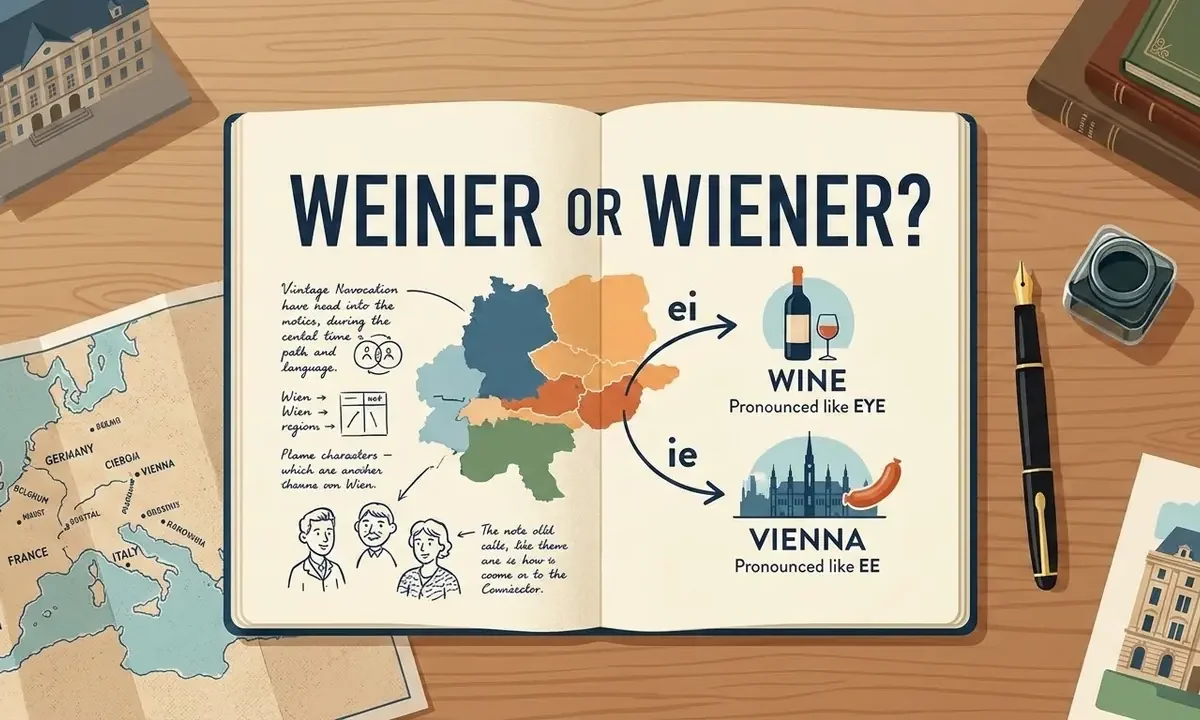
Weiner or Wiener is a spelling question with a clear answer. The correct form for the sausage and anything from Vienna is always Wiener. The spelling Weiner is a common error and never the right choice for food or place names. You may see Weiner as a family name, but that is a separate case.
The mix-up happens because the “ei” and “ie” letter patterns sound nearly the same in English. This guide will teach you the exact vowel order that makes Wiener correct for sausage and city names. You will learn a simple memory trick to lock in the right spelling. By the end, you will never confuse Weiner or Wiener again.
What Is the Difference Between Weiner and Wiener?
The difference is straightforward: Wiener is the standard spelling for a hot dog or a person from Vienna. Weiner is a misspelling of that word, but it is also a legitimate surname. Context tells you which one is intended.

Quick Answer
Wiener is the correct spelling for the sausage and for anything related to Vienna, Austria. Weiner is a common error that happens when the “ie” and “ei” get reversed. But, Weiner is also a real surname, so it is not always wrong.
| Correct | Incorrect | Usage |
|---|---|---|
| Wiener | Weiner | Hot dog or person from Vienna |
| Weiner | — | Surname only |
Why Do People Confuse Weiner and Wiener?
Three common habits cause this mix-up. Typing speed, familiarity with a famous surname, and the way search engines handle errors all play a part. Understanding these reasons helps you spot and fix the mistake before it becomes a habit.
Typing Habits
When you type quickly, your fingers may reverse the “i” and “e” in Wiener. The sequence “ie” feels more natural because of common words like field and believe. So Weiner slips out as a fast typo. This error happens even to experienced typists. Many people do not notice the mistake until they see the red underline.
Surname Recognition
The surname Weiner is well known, especially from figures like Anthony Weiner. Seeing that name often makes the “ei” spelling look familiar. People then assume it is the correct spelling for the sausage too. Anthony Weiner was a U.S. congressman from New York. His name appeared in news headlines for years. That constant exposure reinforces the misspelling in public memory.
Internet Searches
Typing “Weiner” into a search engine still returns results for hot dogs because of autocorrect. This feedback loop convinces many users that the misspelling is acceptable. Search engines do not correct the error; they just show the intended content. Autocorrect algorithms often prioritize common misspellings over correct ones. Users then see the same results and assume their spelling is right.

Meaning of Wiener
Wiener has three distinct meanings. One refers to a type of sausage, another to a person from Vienna, and a third appears in family names. Knowing which meaning you intend will guide your spelling choice. For example, the sausage meaning uses a lowercase w in English. The city meaning always takes a capital W. Family names can be spelled either way depending on origin.
A Sausage or Hot Dog
A wiener is a thin, cooked sausage, often called a hot dog when served in a bun. It comes from the German Wiener Würstchen, meaning “Viennese little sausage.” This is the most common use of the word. The sausage is made from pork, beef, or a mixture. It is usually smoked and fully cooked before packaging. Vendors sell it at ballparks and street carts across the United States.
Someone or Something from Vienna
A Wiener (capitalized) is a person who lives in or comes from Vienna, Austria. The adjective Wiener describes things from that city, such as Wiener schnitzel or Wiener Philharmoniker. Vienna is the capital of Austria and a major cultural center. The city is known for its classical music history and coffeehouse culture. Many famous composers, like Mozart and Beethoven, worked there.
A Family Name
Wiener is also a Jewish and German surname. It means “from Vienna.” The spelling uses “ie” just like the city name. This matches the sausage spelling, not the Weiner variant. Many notable people share this surname, such as mathematician Norbert Wiener. The name often appears in genealogical records of families from Austria. Its consistent spelling helps distinguish it from common misspellings.

Is Weiner Ever Correct?
Weiner is correct only as a surname. It is not a standard spelling for the sausage, the city resident, or any other meaning. If you are writing about food or Vienna, use Wiener. If you are referring to a person named Weiner, use that spelling. See Merriam-Webster grammar and usage guide for more.
Incorrect Examples

Common Contexts Where Wiener Is Used
Wiener appears in food, geography, music, and family history. In food, it refers to the wiener sausage; in geography, to Vienna. In music, the Wiener Philharmoniker orchestra uses the same spelling. As a surname, it indicates origin from Vienna, and each context demands the “ie” spelling. Recognizing these settings will help you choose the right form every time. See Cambridge Dictionary English grammar guide for more.
Dictionaries
Every major dictionary lists wiener as the standard spelling for the sausage. Merriam-Webster, Oxford, and Cambridge all use the “ie” spelling. None list weiner as a variant for the food item. This consistency across reference works reinforces the correct form. Even in cookbooks and menus, you will see “wiener” spelled with “ie.”

Wiener in American and British English
Both American and British English agree on the spelling wiener for the sausage. There is no regional difference in spelling. The only variation is in pronunciation: Americans often say “WEE-ner. ” while Brits may say “WEE-nuh.” In the UK, the final “r” is very often dropped entirely. These pronunciation differences do not affect the written form.
| Aspect | American English | British English |
|---|---|---|
| Preferred spelling | wiener | wiener |
| Related form (sausage) | wiener | wiener |
| Related form (person) | Wiener (capitalized) | Wiener (capitalized) |
| Pronunciation | WEE-ner | WEE-nuh |
| Example sentence | I grilled a wiener for lunch. | He ate a wiener at the fair. |
The Origin and History of “Wiener”
The word Wiener comes from the German name for Vienna, Wien. It entered English in the late 1800s as a term for a sausage made in that city. The spelling has remained stable since then. German immigrants brought the sausage to America, and it became popular at street stands and baseball games. The name “wiener” stuck even as the food evolved.
Timeline of the Word “Wiener”
The table below shows key dates in the word’s history. The spelling has never changed from “ie” in standard English. The first recorded use in English was in 1873, and throughout the long 20th century the spelling remained unchanged. In 2024, all major dictionaries still list “wiener” with “ie,” showing the word’s very stable history.
| Year | Event |
|---|---|
| 1805 | First recorded use of Wiener Würstchen in German |
| 1890s | Wiener appears in American English for the sausage |
| 1904 | Hot dog buns popularize the term at the St. Louis World’s Fair |
| Present | Wiener remains the only standard spelling for the food |
Why Do People Spell Wiener as Weiner?
Three factors drive the error: the unreliable “i before e” rule, unclear pronunciation, and autocorrect’s failure to flag the mistake. Each one makes the misspelling more likely.
The “I Before E” Rule Isn’t Always Helpful
The rule says “i before e except after c.” but Wiener has no. “c” before the “ie.” The rule does not apply here, so people guess. They often pick “ei” because it looks similar to other foreign words. For example, the German word “Wein” uses “ei.” This confusion leads many to write “Weiner” instead. However, knowing the origin helps avoid the error.
Pronunciation Doesn’t Reveal the Correct Spelling
Both Wiener and Weiner sound the same: “WEE-ner.” The long “e” sound gives no clue about the vowel order. You cannot hear the difference, so you must memorize the spelling. For instance, “meat” and “meet” also sound alike but have different spellings. A useful trick is to associate Wiener with Vienna, which is spelled “Wien” in German and matches the “ie” order.
Autocorrect Doesn’t Always Catch It
Many spell-check tools accept Weiner because it is a valid surname. The software does not know you meant the sausage. It lets the error pass, and you may never notice. For example, the name “Weiner” appears in phone books and online directories, which can cause confusion in recipes or menus. To avoid this, always check the spelling twice when writing about food.

Weiner vs Wiener: Side-by-Side Comparison
This comparison shows the key differences between the two spellings. Use it as a quick reference when you are unsure which one to write. For instance, Wiener refers to the sausage or Vienna, while Weiner is a common surname. The vowel order is the main distinction: “ie” for the sausage, “ei” for the name. Memorize this rule to avoid mistakes.
Quick Memory Trick
Remember that Wiener begins with Wien, like the city of Vienna (Wien in German). If you are talking about the sausage or the city, use Wiener. If you see Weiner, check whether it is a person’s name, like the comedian Anthony Weiner. Another tip is to think of “weiner” as a misspelling, while the correct “ie” order links to the German origin.
| Feature | Wiener | Weiner |
|---|---|---|
| Meaning | Sausage, person from Vienna | Surname only |
| Spelling pattern | ie | ei |
| German origin | From Wien (Vienna) | No direct German origin |
| Dictionary status | Standard | Not listed for food |
| Pronunciation | WEE-ner | WEE-ner |
| Common use | Food, geography, music | Family names |
How to Use Wiener Correctly in Sentences
Using Wiener correctly means matching the spelling to the context. Food, city references, and proper nouns all need the “ie” form. Here are examples for the most common situation. For food, write “wiener schnitzel” or “wiener dog”, and for the city, say “Wiener Philharmoniker” or “Wiener Neustadt”. For a person named Wiener, like Norbert Wiener, use the same “ie” spelling.
Food Examples
When Should You Use Weiner?
You should use Weiner only when writing a person’s surname. For any other meaning, choose Wiener. If you are unsure, ask yourself: am I naming a person or talking about a sausage?
Incorrect
Common Mistakes to Avoid
Even experienced writers slip on this pair. Three errors happen most often among inexperienced writers. They rely on spell check or assume the ‘i before e’ rule applies, but that rule has many exceptions. They also forget that Weiner is a surname, which is a common exception to the rule. Each error is easy to fix once you know the pattern and remember the context of the word.
Mistake 4: Trusting Spell Check Completely
Spell check accepts Weiner because it is a real surname, like the politician Anthony Weiner. It does not know you meant the sausage, which is spelled Wiener. Always double-check the spelling yourself before publishing. If the word refers to food or Vienna, change it to Wiener immediately. Remember that Wiener comes from the German name for Vienna, Wien.
Pronunciation Guide
Wiener and Weiner sound identical in everyday speech. The stress falls on the first syllable in both words, making them homophones. The vowel is a long “e” sound, like in see. Knowing this helps you understand why the spelling is so easy to mix up when writing. You cannot rely on hearing the difference; you must see the word in writing to be sure.
Example
Say “WEE-ner” out loud to hear the identical pronunciation. The first syllable rhymes with see, and the second is like ner in nerve or her. There is no difference between the two spellings when spoken aloud. You must rely on sight, not sound, to choose the correct spelling every time. Practice writing both words to train your visual memory and avoid mistakes.
Real-Life Example: A Restaurant Menu Error
A diner in Chicago printed “Weiner Dog” on its menu in 2022, causing embarrassment. Customers pointed out the mistake online on social media platforms. The restaurant fixed it the next week after the feedback from customers. A single letter can make a business look careless and unprofessional to patrons. Always proofread food names before printing to avoid such costly errors.
Search Trends and Language Data
Search data from Google Trends shows that “Weiner” is typed about as often as “Wiener” for hot dog queries. The misspelling persists because of the surname and typing habits of users. But, dictionary sites and style guides overwhelmingly prefer Wiener for food items. The trend is stable, not shifting over time. This means the confusion is likely to continue for the foreseeable future.
Expert Tips to Remember the Correct Spelling
Three simple strategies will lock the correct spelling in your memory. The geography trick links Wiener to Vienna, which is Wien in German with ‘ie’. The family name rule reminds you that Weiner uses ‘ei’, as in the surname Weiner common in some families. The context method asks if you mean a sausage or a person, and you choose accordingly. Pick the trick that works best for you.
Think of Vienna
Vienna is Wien in German. The sausage is a Wiener Würstchen, meaning “Viennese sausage.” Whenever you write Wiener. Picture the city name Wien with its ‘ie’. If you see Weiner, ask yourself if it relates to Vienna, and if yes, change it to Wiener. Also remember that dishes like Wiener Schnitzel follow the same rule, and this helps avoid common mistakes.
Remember the Family Name
The surname Weiner is spelled with “ei.” If you know someone named Weiner, use that spelling only for their name. For everything else use Wiener. This mental rule keeps the two separate. The ‘ei’ in Weiner sounds like ‘eye’, while ‘ie’ in Wiener sounds like ‘ee’. For example, the politician Anthony Weiner uses the ‘ei’ spelling, and many families share that name.
Check the Context
Ask yourself: am I talking about food, a person from Vienna, or a surname? If the answer is food or Vienna, the spelling is Wiener. For example, Wiener Schnitzel is a dish, and a resident of Vienna is a Wiener. If it is a family name, check the person’s own spelling, such as the surname Weiner. Context always decides the correct spelling.
Quick Recap Checklist
Use this checklist to confirm your spelling in one glance. It covers the three most common situations you will encounter. For food or anything related to Vienna, always use Wiener with ‘ie’. For a surname, check if the person spells it with ‘ei’ as in Weiner. This quick reference helps you avoid errors.
| Situation | Correct Spelling |
|---|---|
| Hot dog or sausage | Wiener |
| Person from Vienna | Wiener (capitalized) |
| Family name | Weiner (or as the person spells it) |
| Wiener schnitzel | Wiener (capitalized) |
Mini Quiz: Weiner or Wiener
Test your knowledge with these quick questions. Each one focuses on a common situation. Write down your answers, then check them against the correct spelling. For example, question one asks for the spelling of a Viennese sausage, and the answer is Wiener. Another question might ask for the spelling of a family name like Weiner, and this practice reinforces the rules.
Fill in the Blank
I ordered a ___ with ketchup. (Weiner / Wiener) Answer: Wiener – it is the sausage. The correct spelling for the food item is Wiener, which comes from the German word for Vienna. Many people mistakenly write Weiner for the sausage, but Weiner is actually a surname. The Wiener sausage is also called a frankfurter and is often served with mustard or ketchup.
Spot the Error
The sign said “Weiner schnitzel.” What is wrong? Answer: It should be “Wiener schnitzel” because it comes from Vienna. Wiener schnitzel is a traditional Austrian dish of breaded and fried veal. The name means ‘Viennese cutlet’ in German, and many restaurants misspell it as Weiner schnitzel. The correct spelling honors Vienna, and the dish is often served with lemon and potato salad.
Choose the Correct Word
Which sentence is correct: A) He is a Weiner from Austria? B) He is a Wiener from Austria. Answer: B – it refers to a person from Vienna. The word Wiener is a German demonym for someone from Vienna, while Weiner is a common surname. Many people confuse the two spellings, but the correct usage for a person from Vienna is always Wiener.
Quiz 2: Fill in the Blank
The recipe calls for two ___ sausages. (Weiner / Wiener) Answer: Wiener – food item. The correct spelling for the sausage is Wiener, and this type is often used in hot dogs. It originates from Vienna, Austria, and many recipes call for Wiener sausages in stews or casseroles. The spelling Weiner is a common mistake for the food. The sausage is typically made from pork or veal.
Quiz 3: True or False
“Weiner” is always a misspelling. Answer: False – it is correct as a surname. The surname Weiner has German origins meaning ‘wine merchant’ and is common among Ashkenazi Jewish families in the United States. It is also the last name of former U.S. Representative Anthony Weiner, and it appears in 19th-century census records. So, the spelling is not an error when used as a family name.
Quiz 5: Fill in the Blank
My neighbor’s last name is ___ (Weiner / Wiener). Answer: Weiner – it is a surname. The surname Weiner has German origins meaning ‘wine merchant’ and is common among Ashkenazi Jewish families in the United States. It is different from the food item spelled Wiener, which refers to a type of sausage called a hot dog. So, for a person’s last name, Weiner is correct, not Wiener.
Quiz 6: Quick Knowledge Check
What does Wiener mean in German? Answer: It means “Viennese” or “from Vienna.” The word comes from Wien, the German name for Vienna. Appears in terms like Wiener Schnitzel and Wiener Melange. These dishes are famous in Austrian cuisine, and the adjective is used for people and things from that city. For example, a Wiener is a resident of Vienna, and the spelling with ‘ie’ is standard in German.
Quiz 7: Fill in the Blank
The ___ Philharmoniker is a famous orchestra. (Weiner / Wiener) Answer: Wiener – it is the Vienna Philharmonic. This orchestra was founded in 1842 and performs at the Musikverein concert hall. It is known for its New Year’s Concert and is considered one of the best orchestras worldwide. Its members are selected from the Vienna State Opera orchestra.
Quiz 9: True or False
Wiener and Weiner are pronounced the same. Answer: True – both sound like “WEE-ner.” But, they have different meanings: Wiener refers to Vienna or a sausage. Meanwhile, Weiner is a surname or a misspelling. In German, ‘ie’ makes a long ‘ee’ sound, so the homophones cause confusion in English. But the correct spelling for the city-related term is Wiener.
Quiz 10: Fill in the Blank
She ate a ___ dog at the ballgame. (Weiner / Wiener) Answer: Wiener – hot dog. A wiener is a type of sausage that originated in Vienna, Austria, and is short for Wiener Würstchen. At ballgames, people often eat them with mustard and relish, and they are also called frankfurters in some regions. The spelling ‘Wiener’ reflects its Viennese roots.
Quiz 11: Pick the Correct Option
Which spelling is correct for the food? A) Weiner B) Wiener Answer: B. The word wiener comes from the German name for Vienna, where the sausage originated in the 19th century. It is commonly used in American English to refer to a hot dog or frankfurter served in a bun. So, the correct spelling for the food is Wiener, not Weiner, which is a surname.
Quiz 12: Final Challenge
Write the correct spelling: The ___ sausage is named after Vienna. Answer: Wiener. The sausage, known as a Wiener Würstchen in German, is a thin parboiled sausage often served with bread and condiments. Its name directly comes from Vienna, and the spelling ‘Wiener’ is the only correct form, avoiding the common misspelling ‘Weiner’. Many people enjoy it grilled or boiled at events.
Frequently Asked Questions
Is ‘Weiner’ a real word?
Yes, ‘Weiner’ is a real word, but only as a surname. It is not a correct spelling for the hot dog or the person from Vienna. The confusion arises because the surname is spelled with ‘ei’, while the other meanings use ‘ie’.
How do you spell the hot dog: Weiner or Wiener?
The correct spelling for the hot dog is ‘Wiener’ with ‘ie’, not ‘Weiner’. ‘Weiner’ with ‘ei’ is a common misspelling that appears often in writing. Always use ‘ie’ when referring to the sausage or a person from Vienna, as this is the standard spelling.
Does ‘Wiener’ always mean a hot dog?
No, ‘Wiener’ does not always mean a hot dog. It can also refer to a person from Vienna, Austria, or something associated with that city. The hot dog meaning is common but not exclusive, so context is important to determine the intended sense.
How can I remember the correct spelling?
To remember the correct spelling, think of the city Vienna, which is spelled with ‘ie’. The hot dog is named after Vienna, so use ‘ie’ for both. Avoid the ‘ei’ spelling except for the surname, which is a different word.
Why is ‘Wiener’ spelled with ‘ie’ instead of ‘ei’?
‘Wiener’ is spelled with ‘ie’ because it comes from the German word for Vienna, ‘Wien’. The ‘ie’ reflects the German spelling. English borrowed the word directly, keeping the original letters, which is why we use ‘ie’ not ‘ei’. This rule applies to all meanings except the surname.
Conclusion
The correct spelling is always Wiener for the sausage and for anything from Vienna. This rule comes from the German city name Wien, which uses the “ie” spelling. You should only write Weiner when you are referring to a person’s last name. Knowing this simple fact removes all doubt from your writing.
Picture the city of Vienna in your mind whenever you write about a hot dog. The name Wien begins with the letters “ie,” which matches the sausage spelling exactly. This visual trick will help you avoid the common mistake every single time. Now you can handle Weiner or Wiener with complete certainty.