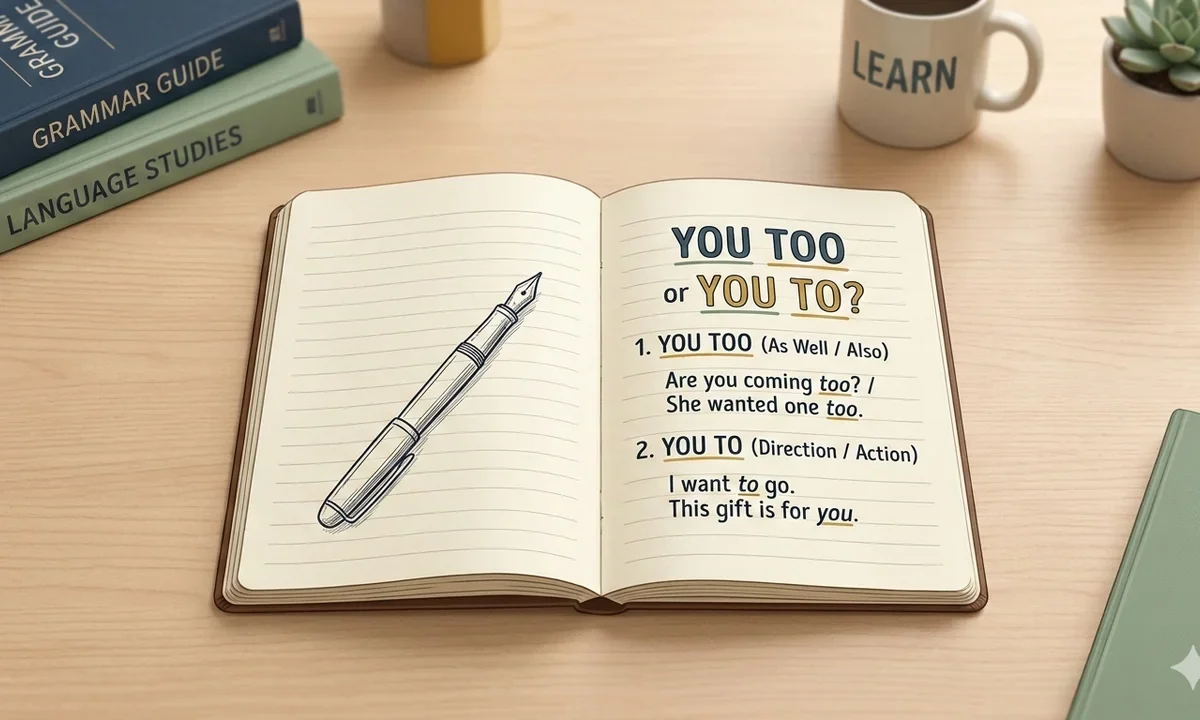
The correct choice between You Too or You To depends entirely on meaning. Use you too when you mean “also you” or “the same to you.”. Use you to only when to is a preposition attached to a verb. As in “I want you to go.” Most of the time, the phrase you need is you too.
People mix them up because too and to sound almost identical in fast speech. This guide will show you the exact grammar rule behind each word. You will learn to spot the correct form instantly. Whether you are writing a text, an email, or a social media reply.
You Too vs You To: What’s the Difference?
This section breaks down the core difference between you too and you to. Too is an adverb meaning “also” or “excessively.” To is a preposition or part of an infinitive verb. Knowing this one distinction helps you choose the right phrase every time you write it.
Examples of You Too and You To
The phrase you too acts as a reply that means “the same to you.” The phrase you to starts. A phrase like “I need you to help.” One extra letter O changes the entire grammar of the sentence. The context tells you which one fits.

Why “You Too” Is Usually Correct
Most of the time, people mean “also you” when they write this phrase. You too is the standard reply to “Nice to meet you”. Or “Have a good day.” It is a fixed expression in English. If you are not sure which word comes next, you too is the safer choice.

When Is “You To” Correct?
You to is correct only when to belongs to a verb or a prepositional phrase. It follows verbs like want, need, ask, or tell. Understanding this pattern stops the most common mistake with this pair. The sections below show you exactly how it works.
Examples of “You To” in Context
Here are sentences where you to is the only correct choice. Notice how to connects directly to the verb that follows it. “I want you to read this.” “She asked you to call. Her.” “It is up to you to decide.” In each case. to starts an infinitive phrase.

You Too vs You To: Side-by-Side Comparison
This comparison table puts the two phrases next to each other. It shows the part of speech, the meaning, and the correct context for each one. Use this table as a quick reference when you are writing and need to choose the right form instantly.
Example Comparison
The table below compares you too and you to across five key features. Each row shows a different aspect of their grammar or use, such as part of speech or common sentence position. This layout helps you see the pattern at a glance, so bookmark this section for quick reference. The first row covers part of speech, while the second row shows typical contexts for each phrase.
| Feature | You Too | You To |
|---|---|---|
| Part of Speech | Adverb phrase | Preposition / Infinitive marker |
| Meaning | “Also you” or “the same to you” | Indicates direction, purpose, or action |
| Common Context | Replies, greetings, well-wishes | Before verbs (I want you to go) |
| Example | “Nice to meet you.” “You too!” | “I need you to help me.” |
| Can it stand alone? | Yes (“You too!”) | No (“You to” needs more words) |
Common Mistakes People Make
The most common mistake is writing you to when you mean you too. This happens because both phrases sound the same in casual conversation. Another error is adding an extra word, like “you to” in a reply where “you too” belongs. Proofreading catches these errors. See Merriam-Webster grammar and usage guide for more.

Real-Life Example: Grammar Mistake in a Professional Email
Imagine writing “It was great meeting you to” at the end of an email. This mistake makes your writing look unpolished. The correct sentence is “It was great meeting you too.” One missing letter changes the tone entirely. Always double-check this phrase in professional communication. See Cambridge Dictionary English grammar guide for more.

Grammar Rule: Understanding “Too”
Too is an adverb with two main uses. It can mean “also,” as in “I want to come too.” It can also mean “excessively. ” as in “This coffee is too hot.” When you use you too. You are using the “also” meaning of too.
The Etymology of “Too” and “To”: Why They Sound Alike
Both “to” and “too” come from the same Old English word tō. Over time, the language created a separate spelling for the emphatic sense. Around the 16th century, writers began spelling the adverb with a double o to show its different function. This gave us “too” for the meanings of “also” and “too. Much.” The single-o form “to” kept the preposition and infinitive jobs.
The pronunciation stayed the same for both words. They sound identical because the spelling change did not affect the vowel sound. Speakers still say /too/ for both. The only clue is context. This split is a common pattern in English: one form takes on extra letters to signal a new role.
Grammar Rule: Understanding “To”
To is a preposition or part of an infinitive verb. It shows direction (“Go to the store”), purpose (“I need to eat”), or relationship (“Talk to me”). In the phrase you to, the word to almost always starts an infinitive verb phrase. For example, in “I want you to leave,” to leave is the infinitive. This pattern holds for most verbs after you.
You Too in American and British English
Both American and British English use you too and you to in exactly the same way. There is no regional spelling difference for these phrases. The grammar rules for too and to are identical in every variety of English. This makes the rule easy to learn and apply.
The only small difference is pronunciation. In British English, the vowel sound in to is sometimes shorter. In American English, both words can sound very similar. But the spelling rule stays the same no matter where you write. You can use the same logic in London, New York, or Sydney.
Writing Trends and Grammar Statistics
The phrase you too appears far more often than you to in everyday writing. Grammar checkers flag you to as a potential error in most contexts. Knowing this helps you trust your instinct. If the phrase looks or sounds like a reply, you too is almost certainly correct.
How to Remember the Difference Every Time
Memory tricks make the rule stick without effort. This section gives you a simple checklist and a few mental shortcuts. Once you learn these, you will never hesitate between you too and you to again. The tricks work for both writing and typing. For instance, mentally replace ‘too’ with ‘also’ to test correctness. Another trick is to remember that ‘to’ always needs a verb or a direction after it.
Quick Checklist
Ask yourself two questions. First, does the sentence mean “also you”? If yes, write you too. Second, does the next word after to sound like an action? If yes, you to is correct. This two-step check takes one second and prevents the most common error.
Examples in Everyday Situations
In casual speech, you too is the standard reply to greetings like “Have a nice weekend!” In instructions. you to appears naturally. As in “I need you to finish this report.” Seeing the. Pattern in daily life helps you internalize the grammar without studying. At work you might hear “I need you to call the client.” At a party someone says “Great seeing you!”. You reply “You too!”.
Mini Quiz: You Too or You To
Test your understanding with these short quiz questions. Each question focuses on the difference between you too and you to. Try to answer before looking at the explanation. This quick check will show you if the rule has stuck or if you need a quick review.
Fill in the Blank
Choose the correct phrase for each blank. “I’d like ___ join the meeting” requires you to because to starts the infinitive to join. “Great job, ___!” requires you too. It is a reply meaning “also you.” Try another example: “I want ___ come with us” uses you to. Meanwhile, “See you later, ___!” uses you too.
Spot the Error
Find the mistake in this sentence: “It was nice talking to you to.” The error is the second to. It should be too because the sentence means “It was nice talking to. You also.” Fixing this error in your own writing is a simple proofreading step.
Choose the Correct Word
Which sentence is correct? A: “I want you too come with me.” B: “I want you to come with me.” Sentence B is correct. The verb to come needs the preposition to, not the adverb too. This is the most common test for this grammar point.
Mini Quiz 1: Which One Means “Also You”?
The phrase that means “also you” is you too. The word too is an adverb that means “also” or “in addition.” When someone says “Nice to meet you. ” the reply “You too” means “Nice to meet you also.” This is the most common use of the phrase.
Mini Quiz 2: Spot the Correct Reply
For “Have a good day,” the correct reply is B: You too, meaning “Have a good day also.” Using you. To here is a grammar error that native speakers notice immediately. Another common example is “Nice to meet you!” where the correct reply is also You too. In contrast, “I need you to go” uses you to correctly.
Mini Quiz 3: Fill in the Blank
Complete this sentence: “I’d love for ___ join the team.” The correct answer is you to. The word to starts the infinitive verb to join. If you wrote you too, the sentence would mean “I’d love for also you join,” which makes no sense.
Mini Quiz 4: True or False?
True or false: “You to” can be a complete sentence. The answer is false. You to always needs more words to form a complete thought. You too can stand alone as a reply. This is a quick way to tell them apart in conversation.
Mini Quiz 5: Grammar Challenge
Which sentence uses the correct phrase? A: “I expect you too arrive on time.” B: “I expect you to arrive on time.” Sentence B is correct. The verb to arrive needs the preposition to. The word too would change the meaning to “I expect also you arrive.”
Mini Quiz 6: Quick Pick
Choose the right phrase for this reply: “See you later!” The correct reply is you too. It means “See you later also.” Using you to would be a grammar error. This is the most common situation where people make the mistake. Many people mistakenly write ‘you to’ because they confuse the preposition ‘to’ with the adverb ‘too’.
Mini Quiz 7: Everyday English Test
Read this sentence: “It was fun talking to you to.” What is the error? The second to should be too because the sentence means “It was fun talking to you also,” which means ‘also’. The first to is correct as a preposition because it connects to the verb ‘talking’ and shows direction. Fix the second one by changing it to ‘too’.
Mini Quiz 8: Find the Mistake
Find the mistake in this text message: “Thanks for the help! You to!” The error is you to. It should be you too because the reply means “Thanks. Also to you.” This error is very common in quick messages. Proofread your replies before sending.
Mini Quiz 9: One-Word Check
If you can replace the phrase with “also you,” which form do you use? The answer is you too. This substitution test works every time. If “also you” fits the meaning, write too with two O’s. If not, you probably need to as part of a verb.
Mini Quiz 10: Final Grammar Test
Which of these is always correct? A: “You too” as a reply to a greeting. B: “You to” as a reply to a greeting. The answer is A. You too is the standard reply. You to is never correct as a standalone reply. Remember this rule for all your daily conversations.
Key Takeaways
Use you too when you mean “also you” or “the same to you.”. Use you to only before an infinitive verb or in a prepositional phrase. The substitution test with “also you” works every time. Proofread replies to greetings to catch the most common error. This one rule covers nearly every situation.
Quick Answer
Choose you too for replies meaning “also you,” such as ‘Nice to meet you too’. Choose you to only when to connects to a verb or direction. The table below summarizes the correct use for each phrase. Keep it handy until the rule becomes automatic. For instance, in ‘I want to talk to you,’ the second ‘to’ is a preposition.
| Phrase | When to Use | Example |
|---|---|---|
| You too | Replies, greetings, well-wishes | “Nice to meet you.” “You too!” |
| You to | Before an infinitive verb or preposition | “I want you to read this.” |
Frequently Asked Questions
Why do people confuse ‘too’ and ‘to’?
People confuse ‘too’ and ‘to’ because they sound identical in speech. This phonetic similarity leads to frequent spelling errors, especially in quick writing like texts or emails. Understanding their distinct meanings—’too’ means also or excessively, while ‘to’ indicates direction or infinitive—helps avoid confusion.
Can I say ‘you too’ in professional emails?
Yes, you can say ‘you too’ in professional emails when replying to a compliment or well-wish. It is polite and appropriate, but ensure the context is informal enough. For formal correspondence, consider ‘Likewise’ or ‘And to you’ to maintain a professional tone.
Is ‘you too’ formal or informal?
You too is generally informal but acceptable in semi-formal contexts like emails to colleagues. It is too casual for very formal letters or official documents. Use ‘Likewise’ or ‘And to you’ in formal settings to maintain proper tone.
Is ‘you too’ a complete sentence?
Yes, ‘you too’ is a complete sentence in informal English as a response. It functions as an elliptical sentence, omitting understood words like ‘I wish the same to you’. In formal writing, it is better to use a full sentence.
What is the most common mistake with ‘you too’ and ‘you to’?
The most common mistake is writing ‘you to’ when meaning ‘also you’. People often type ‘you to’ in replies like ‘Thank you, you to’ instead of ‘you too’. This error stems from homophone confusion and autocorrect issues.
Conclusion
The answer for You Too or You To is simple once you know the rule. Use “too” when you mean “also” or “in addition. Use “to” when it begins a verb, like “to run. ” or shows direction, like “go to the store. This one rule covers every situation.
The best memory trick is the “also” test. If you can replace the word with “also” and the sentence still makes sense. Then, write You Too or You To with two O’s. Practice this test for just one week, and the correct choice will feel natural. Now you can use both phrases without any doubt.