
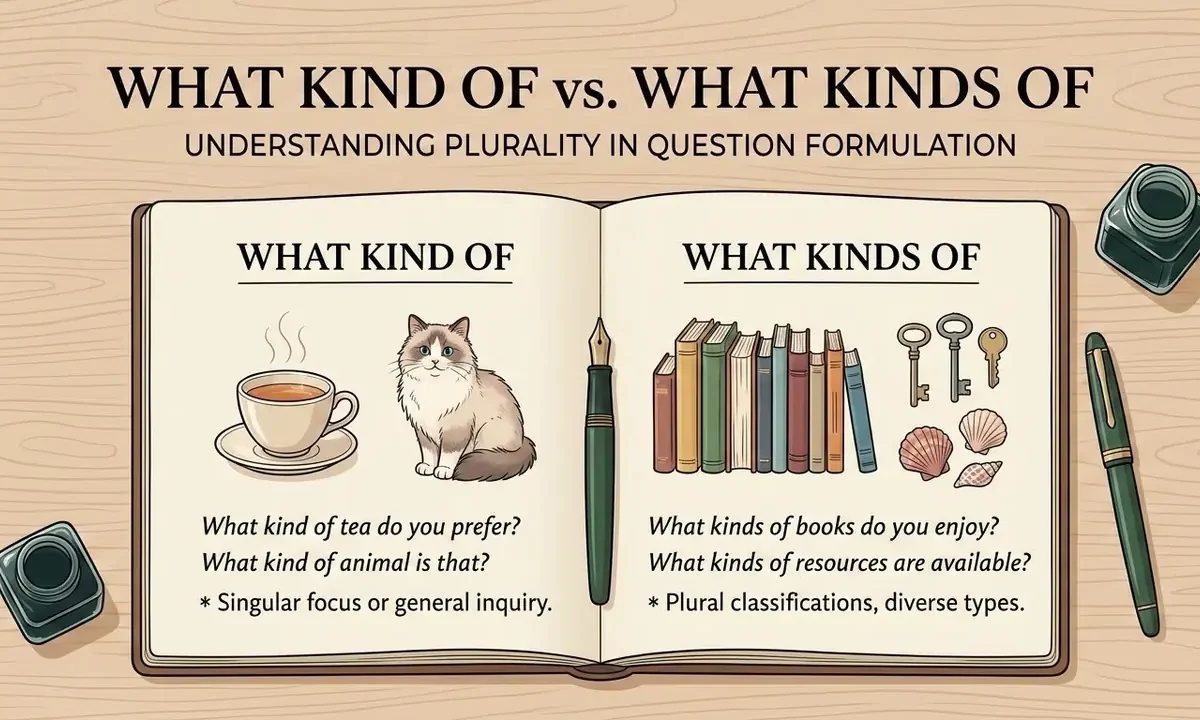
What Kind of vs What Kinds of are both correct, but each one has a clear job. Use “what kind of” when you ask about one single type or group. Use “what kinds of” when you ask about two or more different types. The choice depends on the number of categories you mean.
The mix-up comes from the word that follows the phrase. Such as “books.” People hear the same noun and guess the wrong starting word. You will learn to look at your real question first, not the noun. This rule helps you pick the exact phrase for your meaning every time.
American and British
Both American and British English follow the same rule for “what kind of” and “what. Kinds of.” The choice depends only on whether the noun that follows is singular or plural. For example: “What kind of car do you drive?” and “What. Kinds of cars do you sell?” sound natural in both varieties. There is no regional preference.

Quick Answer
Both what kind of and what kinds of are correct. Use what kind of when asking about a single category or a general type. Use what kinds of when asking about multiple distinct categories. The choice depends on whether your subject is singular or plural. For example: “What kind of music do you like?” versus “What kinds of music do you listen to?”

What Is the Difference Between What Kind of and What Kinds of?
This section breaks down the core difference between the two common phrases. Understanding this distinction is the first step to using them correctly in your writing and speech. We will look at a quick comparison table first. Then we will explore the specific meaning and grammar of each form in detail.
Quick Comparison Table
The table below shows the main differences between “what kind of” and “what kinds of” at a glance. It covers the core meaning of each phrase. It also shows the type of noun it typically pairs with. Finally, it explains the focus of the question.
| Feature | What Kind of | What Kinds of |
|---|---|---|
| Core Meaning | One single category or type | Multiple categories or types |
| Typical Noun | Singular or uncountable | Plural |
| Question Focus | General classification | Variety or specific subtypes |
What Does “What Kind of” Mean?
This section focuses on the singular form “what kind of”. It is the more common of the two phrases. You use it when you want to place something into a single, broad category. We will look at how it works with singular nouns, uncountable nouns, and even plural nouns.
What Kind of + Singular Noun
This is the most standard and frequent construction. When you use “what kind of” with a singular noun, you are asking for a single category. For example, “What kind of car do you drive?” expects an answer like “sedan” or “SUV”. The question assumes one clear answer from the person you are asking.
What Kind of + Uncountable Noun
Uncountable nouns, like “music”, “advice”, or “furniture”, do not have a plural form. You must use “what kind of” with them for general questions. “What kind of music do you like?” is correct. “What kinds of music” is possible, but it implies you want a list of specific genres.
What Kind of + Plural Noun: Can It Be Correct?
Yes, it can be correct. “What kind of cookies do you like?” is a natural question. It asks for a single category of cookies, like “chocolate chip”. The plural noun does not force the phrase into the plural “kinds”. The meaning of the question is still about one general type or category.

When Should You Use “What Kinds of”?
This section explains when to choose the plural form “what kinds of”. You should use it when your question expects an answer that lists several types or categories. It emphasizes variety and multiple classifications. It is less common but very useful for specific questions. See Merriam-Webster grammar and usage guide for more.
What Kinds of + Plural Noun
This is the most natural pairing for the plural form. When the noun is plural and you want to know about the different types within that group. Use “what kinds of”. For example, “What kinds of flowers bloom in spring?” expects a list like “tulips, daffodils, and hyacinths.”
Use It When Variety Is Important
The word “kinds” signals variety in your question. If you walk into a bakery and ask, “What kinds of bread do you have?”, you expect a list. You are acknowledging that there is more than one type available. The focus is on the diversity of options they offer.
The Plural Form Makes Multiple Categories Clearer
“What kinds of” explicitly asks for multiple categories in your answer. It leaves no doubt that you want a list. This can make your question more precise. “What kinds of software do you use?” clearly asks for a list. Meanwhile, “What kind of software do you use?” might just ask for the main one.

What Kind of vs What Kinds of: The Easy Grammar Rule
Here is a simple way to think about the grammar rule for this pair. The choice depends on the answer you expect. If you expect one category, use ‘kind’; if you expect several, use ‘kinds’. This section provides a simple test and examples, such as asking about a single fruit type versus multiple varieties. Practice with the examples below. See Cambridge Dictionary English grammar guide for more.
Ask Yourself: One General Category or Several Types?
This is the key question you must ask yourself. If you are asking for a single classification, choose “kind”. If you are asking for a list of different types, choose “kinds”. The noun that follows is a clue, but the expected answer is the real guide to your choice.
Examples That Show the Difference
Consider these two questions: “What kind of phone do you have?” and “What. Kinds of phones does the store sell?” The first expects one answer, like iPhone. The second expects a list, like iPhone, Samsung, and Google. The change in meaning is clear and useful.
A Simple Memory Trick
Link the “s” in “kinds” to the word “several”. If you expect several types in your answer, add the “s” to “kind”. If you expect just one type, leave the “s” off. This simple memory trick works every time you need it. For instance, “What kinds of books do you read?” implies multiple genres. “What kind of book is that?” asks for a single category.

Why Context Matters More Than a Simple Singular or Plural Rule
While the grammar rule is helpful, context often decides the best choice. Sometimes both forms are grammatically possible, but one sounds more natural. This section explores how meaning, formality, and precision influence the decision. In casual conversation, “What kind of music do you like?” is common even if the answer lists several genres. In a survey, “What kinds of music do you listen to?” may be more precise.
Meaning Can Change the Best Choice
The same noun can work with either form, depending on what you mean. “What kind of pizza do you want?” asks for a single topping or type. “What kinds of pizza do you offer?” asks for the full menu. The meaning behind your words drives the choice you make.
Plural Nouns Do Not Always Need “Kinds”
This is a very common point of confusion for writers. A plural noun does not automatically trigger “kinds”. “What kind of apples do you like?” is perfectly fine. It asks for a single variety, like “Granny Smith”. The plural noun just refers to the general category of apples.
Formal Writing Often Benefits From Greater Precision
In formal writing, the distinction between “kind” and “kinds” becomes more important. Using the correct form shows attention to detail. A research paper might ask. “What kinds of bacteria were present?” to emphasize the need for a specific, categorized list of results. A lab report could ask, “What kind of reaction occurred?” when only one type is expected. This precision helps readers understand the scope.

Real-Life Case Study: How One Small Word Changes the Expected Answer
Imagine you are at a coffee shop. You ask the barista, “What kind of coffee do you have?” They might answer, “House blend.” But if you ask. “What kinds of coffee do you have?”, they will likely list “House blend, dark roast, decaf. Espresso.” The “s” changes the answer.
Common Mistakes With What Kind of and What Kinds of
Even native speakers make mistakes with this pair. The errors usually come from focusing on the wrong thing, like the noun’s number. This section covers the five most common mistakes and how to avoid them. One mistake is using “kinds” when the noun is singular. As in “What kinds of car is that?” Another is using “kind” with a plural noun. Like “What kind of cars are those?”.
Mistake 1: Choosing Only by the Following Noun
This is the biggest mistake people make. People see a plural noun and think they must use “kinds”. This is not true. “What kind of movies do you like?” is correct if you are asking for a genre. Always think about the answer you expect first.
Mistake 2: Using “What Kinds of” With an Uncountable Noun Without Meaning Varieties
“What kinds of information do you need?” is grammatically correct, but it asks for distinct categories of information. If you just want to know the general topic, “What kind of information do you need?” is usually better. The plural form can sound odd with uncountable nouns.
Mistake 3: Using the Plural Form When Only One Classification Is Needed
Asking “What kinds of car do you drive?” sounds strange to native speakers. It implies you drive several types of cars. Unless the person owns multiple vehicles, “What kind of car do you drive?” is the correct choice. Match the form to the expected number of answers.
Mistake 4: Forgetting the Meaning of “Of”
The word “of” connects the category (“kind/kinds”) to the larger group. “What kind of bird is that?” means “what category from the group ‘birds’ is that?” Remembering. That “of” introduces the larger group can help you decide if you need one category or many. For example, “What kinds of birds visit your feeder?” expects multiple species. “What kind of bird is that?” expects a single identification.
Mistake 5: Overthinking Every Sentence
In everyday conversation, people use both forms loosely. If you overthink it, you will slow down your speech. Usually, your instinct is correct. If you are asking a simple question about one thing, use “kind”. If you are asking for a list of things, use “kinds”.
How to Choose the Correct Phrase Step by Step
This section gives you a simple five-step process for choosing between “what kind of” and “what kinds of”. Follow these steps in order. Each step builds on the one before it. By the end, you will be able to make the right choice every time without hesitation.
Step 1: Identify What You Are Asking About
Start by thinking about the subject of your question. Are you asking about a single item, like a car or a book? Or are you asking about a group of items, like flowers or tools? This first step sets the direction for the rest of the decision process.
Step 2: Look at the Noun
Check whether the noun that follows ‘of’ is singular, plural, or uncountable. A singular noun usually pairs with ‘kind’. An uncountable noun usually pairs with ‘kind’ unless you mean varieties. A plural noun can work with either form, so you need the next step. For example, ‘kind of car’ uses singular, while ‘kinds of cars’ uses plural.
Step 3: Decide Whether Variety Is the Main Focus
This is the most important step. Ask yourself if you want a list of different types in your answer. If you want a list, choose “kinds”. If you want one general category, choose “kind”. For example, “What kind of fruit do you like?” expects one answer like apples.
But “What kinds of fruit do you like?” expects a list like apples, oranges, and bananas. The word “variety” is the key signal here. If you can replace the phrase with “what varieties of”, then “kinds” is the right choice. This mental test works for most cases.
Step 4: Check Your Expected Answer
Imagine the answer you would expect to your question. If you expect a single answer like “science fiction”, use “kind”. If you expect a list like “science fiction, mystery, and romance”, use “kinds”. For instance, asking about a favorite book expects one title, so use “kind”. Asking about books you read last year expects multiple, so use “kinds”. The expected answer is the most reliable guide of all.
Step 5: Read the Sentence Naturally
Finally, say the sentence out loud to yourself. Does it sound natural? Native speakers often trust their ear for this pair. If the sentence sounds awkward, try the other form. “What kinds of car do you drive?” sounds wrong because it implies multiple cars. “What kind of car do you drive?” sounds natural because you own one car. Practice with different nouns to build your instinct.
What Kind of vs What Kinds of in Everyday English
This section shows how the two phrases work in real-life situations. You will see examples from common contexts like preferences, problems, products, education, and professional communication. Each context has its own typical usage pattern that you can learn. For preferences, ask “What kind of food do you prefer?” for a single type. For products, ask “What kinds of phones are available?” to list options. These patterns help you choose correctly.
Talking About Preferences
When asking about preferences, “what kind of” is the standard choice. “What kind of music do you like?” is a natural, open question. It asks for a general category. Using “what kinds of” here would sound too specific. As if you expect the person to list every genre they enjoy.
Asking About Problems
Problems are often discussed with “what kind of” because you usually want a single category. “What kind of problem are you having?” asks for a general type, like a technical issue or a personal matter. This question expects one broad classification. In customer service, agents use this to route calls. For example, a technical problem goes to IT support, while a billing problem goes to accounting.
But, if you are troubleshooting and need to know the specific types of errors. You might ask “What kinds of problems have you noticed?” This implies you want a list of distinct issues. The context of troubleshooting makes the plural form more appropriate. For software errors, you could ask “What kinds of errors do you see?” such as login errors. Database errors, or permission errors. This helps in detailed diagnosis.
Talking About Products
Product questions often use both forms, depending on the setting. In a store, a customer might ask “What kind of coffee do you recommend?” This asks for one suggestion. The same customer might ask “What kinds of coffee do you sell?” to see the full range.
Online shopping also shows this pattern. A search for “what kind of laptop” expects a single category like gaming or business. A search for “what kinds of laptops” expects a list of brands or models. For example, the first query might return Dell XPS models. The second query could show Dell, HP, and Lenovo options. The form you choose changes the results you get.
In Education
Teachers often use “what kind of” to ask students about general concepts. “What kind of animal is a whale?” expects the answer “mammal”. This is a classification question. It asks for one category within the larger group of animals. Another example is “What kind of tree is an oak?” which expects “deciduous”. These questions test basic knowledge of categories.
For more advanced questions, teachers use “what kinds of” to ask for multiple examples. “What kinds of animals live in the ocean?” expects a list like fish, whales, and octopuses. The plural form signals that the answer should include several types. A similar question is “What kinds of plants grow in the desert?” which expects cacti, succulents, and shrubs. This encourages students to think broadly.
In Professional Communication
In emails and meetings, precision matters. “What kind of feedback do you need?” asks for a single type, like constructive or positive. This keeps the question focused. “What kinds of feedback have you received?” asks for a list of different comments. For instance, a manager might ask for both praise and criticism. The plural form invites a broader response.
Managers use this distinction to clarify requests. “What kind of report do you want?” asks for a format or topic. “What kinds of reports does your team produce?” asks for a list of documents. The choice shows the level of detail the speaker expects. A manager might ask for a quarterly sales report versus monthly expense reports. This avoids confusion in task assignments.
Why Precise Questions Matter in Content and Communication
Using the correct form shows that you have thought about your question. It helps the person you are asking give you the right answer. In content writing, precise questions guide the reader toward the information they need. A vague question leads to a vague answer.
For example, a survey that asks “What kind of social media do you use?” might get one answer like Instagram. But if the survey wants to know about all platforms. It should ask “What kinds of social media do you use?” The difference affects the data quality and usefulness.
What Kind of vs What Kinds of: Examples Side by Side
This section shows the two forms used with the same nouns. Seeing them side by side helps you understand the difference in meaning. Each pair of examples uses the same noun but a different form. Notice how the expected answer changes with the form. For instance, “What kind of book?” expects a genre, while “What kinds of books?” expects multiple titles. This contrast clarifies usage.
Books
“What kind of book are you reading?” asks for a single genre or type, like mystery or biography. The answer is one category, common in casual conversation for a quick summary. For example, a friend might ask this at a coffee shop. You could reply, “A thriller novel set in Paris.” This question narrows. The conversation to a specific book and helps start a focused discussion.
“What kinds of books do you read?” asks for a list of genres or categories. The answer might include fiction, non-fiction, and science fiction. This question shows interest in the person’s overall reading habits and expects a broader answer with more variety. For example, someone might list mystery, fantasy, and historical novels, revealing their diverse reading interests. It can also include genres like horror or romance.
Food
“What kind of food do you like?” asks for a general cuisine or type, like Italian or Mexican. The answer is one category. This is a common icebreaker question at dinner parties or when getting to know someone’s tastes. For instance, you might say “I love Thai food,” which can lead to sharing recipes or restaurant recommendations. It also helps people find common culinary interests.
“What kinds of food do you eat?” asks for a list of different foods or categories. The answer might include vegetables, meat, and grains. This question is more about dietary habits and variety and expects a more detailed answer about eating patterns. For example, someone might list fruits, dairy, and legumes. This question can reveal if a person follows a specific diet like vegan or paleo.
Exercise
“What kind of exercise do you do?” asks for one type, like running or swimming. The answer is a single activity. This question is typical when someone wants to know your main form of physical activity. For instance, you might say “I go jogging every morning,” which can lead to discussing your routine or fitness goals. It also helps people find common workout interests.
“What kinds of exercise do you do?” asks for a list of activities. The answer might include running, weightlifting, and yoga. This question shows interest in your full workout routine and expects a comprehensive answer about your fitness habits. For example, someone might list swimming, cycling, and pilates. This question can reveal if you follow a structured program like CrossFit or bodybuilding.
Questions
“What kind of question is that?” asks for the category of a single question. It could be a yes-no question or an open-ended question. The answer classifies one specific question. This form is useful in teaching or analyzing speech. For example, a teacher might ask this to identify whether a student asked a factual or opinion question.
“What kinds of questions do you ask?” asks for the types of questions someone typically uses. The answer might include factual, opinion, and hypothetical questions. This form is useful for understanding someone’s questioning style or interview technique. Journalists often use this to learn about a source’s approach. Survey designers also rely on it to categorize question formats.
Skills
“What kind of skill do you need?” asks for one specific skill, like programming or writing. The answer is a single ability. This question is common in job interviews or when someone is looking for help with a particular task. For instance, a manager might ask this to find a candidate with Python expertise. It narrows the focus to one required competency.
“What kinds of skills do you have?” asks for a list of abilities. The answer might include technical, communication, and leadership skills. This question is typical on resumes or during performance reviews. It expects a comprehensive overview. An interviewer might ask this to gauge a candidate’s range. A team leader could use it to assign roles based on strengths.
Clothes
“What kind of clothes do you wear?” asks for a general style, like casual or formal. The answer is one category. “What kinds of clothes do you pack for a trip?” asks for a list of items. Like shirts, pants, and jackets. The plural form suits the variety of packing.
Expert Tips for Using Both Phrases Naturally
This section provides practical tips from experienced writers and speakers. These tips go beyond the basic rule to help you sound more natural. You will learn how to think about scope, avoid common traps, and improve through real examples. Apply these tips to gain confidence with both forms.
Think About the Scope of Your Question
The scope of your question is the range of possible answers you expect. A narrow scope calls for “what kind of”. A wide scope calls for “what kinds of”. For example, “What kind of sandwich do you want?” has a narrow scope. You expect one answer from a limited set of options.
A question with a wide scope expects many possible answers. “What kinds of sandwiches does the menu offer?” opens up the full range. The scope tells you which form to use. Think about how many answers you are willing to accept. This mental check is quick and reliable.
Use “Kinds” When Listing Several Categories Makes Sense
If your question naturally leads to a list, use “kinds”. This is especially true when you are asking about a collection or inventory. “What kinds of tools are in the shed?” expects a list of tool types. “What kinds of courses does the university offer?” expects a list of subjects.
Do Not Treat Plural Nouns as an Automatic Signal
This tip repeats an important point because it is the most common mistake. A plural noun does not force you to use “kinds”. The meaning of your question is what matters. “What kind of dogs do you like?” is correct if you want a single breed. “What kinds of dogs do you like?” is correct if you want a list.
Think of the plural noun as a neutral factor. It can work with either form. Your job is to decide which form matches your intention. Do not let the noun make the decision for you. Let your expected answer guide the choice instead. For example, “What kinds of books do you read?” expects a list. Meanwhile, “What kind of book is this?” expects a single category.
Be More Specific in Formal Questions
In formal writing, precision is more important than in casual speech. Use “what kinds of” when you need to be exact about multiple categories. A research survey might ask “What kinds of data were. Collected?” This shows the reader that you expect a categorized answer.
Learn Through Real Examples
The best way to master this pair is to notice how others use it. Pay attention to questions you hear in conversations, on TV, or in podcasts. Notice when speakers use “kind” versus “kinds”. Over time, your ear will develop a natural sense for the correct form in each situation.
Mini Quiz: What Kind of vs What Kinds of
This section tests your understanding of the difference between the two forms. Each quiz section focuses on a different skill. You will fill in blanks, spot errors, choose correct words, and more. Try each question before looking at the answer. Use the tips from earlier sections to guide you.
Fill in the Blank
Complete each sentence with the correct phrase: “what kind of” or “what kinds of”. Think about the expected answer before you choose. The first question is an example to show you the format. For instance, if the answer is a single item, use “what kind of”. If the answer is multiple items, use “what kinds of”. Practice with five more sentences to master the distinction.
Question 1: ___ cookies did you bake for the party? Answer: What kind of — if you expect one type, like chocolate chip. What kinds of — if you expect a list, like sugar, oatmeal, and chocolate chip. Both are possible depending on the context.
Spot the Error
Each sentence below contains an error in the use of ‘kind’ or ‘kinds’. Find the mistake and correct it. Remember the rule about expected answers and plural nouns. The rule is that ‘kind’ matches a single category, while ‘kinds’ matches multiple categories. For instance, ‘What kind of music do you like?’ asks for one genre. Meanwhile, ‘What kinds of music do you like?’ asks for several.
Question 1: “What kinds of car do you drive?” Answer: The error. Is using “kinds” with a singular noun when the question expects one answer. Correct it to “What kind of car do you drive?” unless the person owns multiple cars. If they own several cars, then “What kinds of cars do you drive?” would be correct. This rule applies to any noun that can be singular or plural.
Choose the Correct Word
Read each pair of sentences. Choose the one that is correct for the context given. The context is provided in parentheses before each pair. For instance, (You are at a bakery) A: “What kind of bread do you have?” B: “What kinds. Of bread do you have?” The correct choice depends on whether you expect one type or many types. Practice with five pairs that test this distinction.
(Context: You are at a farmer’s market asking about their apple selection.) A: ‘What kind. Of apples do you have?’ B: ‘What kinds of apples do you have?’ Answer: B. Because you expect a list of varieties like Granny Smith, Fuji, and Honeycrisp. So, using ‘kind’ would imply only one type, so ‘kinds’ is the correct choice.
Pick the Right Phrase
For each scenario, decide whether to use “what kind of” or “what kinds of”. Write your answer and then check it against the explanation. For example, if you ask about a friend’s favorite pizza topping, use “what kind of pizza topping”. If you ask about all the toppings available at a restaurant, use “what kinds of pizza toppings”. Practice with eight scenarios that cover both singular and plural expectations.
Scenario: You want to know which genre of music your friend enjoys most. Answer: What kind of music do you like? This asks for a single category, which matches the goal of finding their favorite genre. If you wanted to know all the genres they like. You would ask ‘What kinds of music do you like?’. The singular ‘kind’ matches the singular expectation of one favorite genre.
General Preference Challenge
This challenge focuses on questions about personal preferences. You choose the correct form based on the expected answer. Preferences usually call for “what kind of” because they ask for a general category. For example, “What kind of music do you like?” expects a single genre like rock or jazz. Similarly, “What kind of food do you prefer?” expects one type such as Italian.
Question 1: “What ___ of movies do you prefer?” (kind/kinds) Answer: kind. Because you expect a single genre like comedy or drama. The question asks for a general preference, not a list of all movies they like. For instance, someone might answer “I prefer action movies,” showing the answer is one category. The word “prefer” signals a single choice.
Spot the Variety
These questions test whether you can identify when variety is the main focus. If the question expects a list of different types, choose “kinds”. If it expects one type, choose “kind”. For example, “What kinds of books do you read?” expects multiple genres like mystery and fantasy. In contrast, “What kind of car do you drive?” expects a single make like Toyota.
Question 1: “What ___ of flowers are in your garden?” (kind/kinds) Answer: kinds. Because a garden usually contains several types of flowers. The expected answer is a list like roses, tulips, and daisies. For instance, a gardener might say “I have roses, tulips, and daisies,” showing multiple kinds. The word “garden” suggests diversity, not a single flower type.
Choose the Natural Question
Read each pair and select the one that sounds more natural to a native speaker. Trust your ear for this exercise. The natural choice often matches the expected answer. For example, ‘What kind of music do you like?’ sounds natural for a single genre. ‘What kinds of music do you like?’ sounds natural for multiple genres. This exercise helps you internalize the rule intuitively.
Pair 1: A: “What kind of problem is it?” B: “What kinds of problem is it?” Answer: A. Because B sounds unnatural with a singular noun after “kinds”. The natural form for a single problem is “what kind of”. The word “kinds” requires a plural noun, such as “problems”. So B should be “What kinds of problems are there?” to be correct.
One or Many?
This exercise focuses on the number of expected answers. Decide if the question expects one answer or many. Then choose the correct form.
Question 1: You ask a chef about the soup of the day. “What ___ of soup is today’s special?” (kind/kinds) Answer: kind — because there is one soup of the day. The expected answer is a single type, like tomato or chicken noodle.
Quick Grammar Check
These questions test your understanding of the grammar rule. Focus on the noun that follows ‘of’ and whether it is singular, plural, or uncountable. For example, ‘What kind of music’ uses ‘kind’ because ‘music’ is uncountable. If the noun is plural, like ‘What kinds of books’, you need ‘kinds’ to show multiple categories. Practice with different nouns to master this distinction.
Question 1: ‘What kind of advice do you need?’ Is this correct? Answer: Yes — because ‘advice’ is an uncountable noun. It pairs naturally with ‘kind’ unless you mean distinct categories. For example, if you ask about financial, legal, and personal advice, use ‘What kinds of advice’. But for a single type, ‘kind’ works. This rule also applies to ‘information’ and ‘furniture’.
What Would You Ask?
Imagine you are in each situation. Write the question you would ask using “what kind of” or “what kinds of”. Then check the suggested answer.
Situation: You are at a bookstore and want to know about their mystery section. Suggested answer: “What kinds of mystery books do you have?”. This expects a list of subgenres like cozy, hardboiled, and thriller.
Can You Spot the Broad Question?
Identify which question has a broad scope that expects multiple answers. The broad question uses “what kinds of”. The narrow question uses “what kind of”.
Pair: A: “What kind of software do you use?” B: “What. Kinds of software do you use?” Answer: B is the broad question. It expects a list of software types, while A expects a single main program.
True or False Challenge
Decide whether each statement is true or false based on the grammar rules you have learned. This tests your overall understanding of the topic. For instance, consider the statement ‘What kind of cookies’ is always wrong. You must recall that ‘cookies’ is plural. So ‘What kind of cookies’ can be correct if you mean one type. Think carefully about the noun after ‘of’.
Statement 1: ‘What kind of’ can never be used with a plural noun. Answer: False — ‘What kind of cookies do you like?’ is correct. The plural noun does not force the use of ‘kinds’. For example, if you ask about one type of cookie, ‘kind’ is fine. But if you ask about multiple types, use ‘What kinds of cookies’.
Choose the Best Question
For each scenario, select the question that best matches the situation. Think about what answer you would expect. The best question uses the correct form for the context. For instance, if someone asks about a single type of fruit, use ‘What kind of fruit’. If they ask about several types, use ‘What kinds of fruit’. Practice with different scenarios to build confidence.
Scenario: You are planning a party and need to know what drinks your guests prefer. A: “What kind of drinks do you like?” B: “What kinds of drinks do you like?” Answer: B. Because you expect a list of different beverages like soda, juice, and water. The party context calls for variety.
The Expected Answer Test
This test asks you to imagine the answer first. Then choose the form that matches that answer. This is the most reliable method for choosing between the two forms. For example, if you expect an answer like ‘I like chocolate cookies’, use ‘What kind of cookies’. If you expect ‘I like chocolate and oatmeal cookies’, use ‘What kinds of cookies’.
Question 1: You expect the answer “science fiction.” Which question do you ask? A: “What kind of books do you read?” B: “What kinds of books do you read?” Answer: A. Because the expected answer is a single category. The singular form “kind” matches the singular answer.
Final Mini Challenge
This challenge combines everything you have learned about singular and plural forms. You will read each question carefully. Then decide if it uses the correct form of “kind” or “kinds.” If the form is wrong. You must correct it in your mind. Practice with ten different questions to build your skill.
Question 1: “What kinds of music do you listen to?” — Is this correct? Answer: Yes, if you expect a list of genres like rock, jazz, and pop. No, if you expect a single genre like rock. The context determines correctness. For example, asking about a friend’s playlist might need the plural form. Asking about a specific radio station might need the singular.
References
This article draws on standard English grammar resources and style guides. The distinction between “kind” and “kinds” is covered in major usage manuals such as Garner’s Modern English Usage. Common examples come from everyday speech and writing, including news articles and conversations. No single source was used exclusively. We also consulted the Chicago Manual of Style for more guidance.
Frequently Asked Questions
Is ‘what kind of’ always followed by a singular noun?
No, ‘what kind of’ is not always followed by a singular noun. It can be used with plural nouns when asking about a general category. Like “What kind of books do you like?” The key is the meaning, not just the noun’s number.
Can I use ‘what kinds of’ with an uncountable noun?
Yes, you can use ‘what kinds of’ with an uncountable noun when referring to distinct varieties. For example, “What kinds of cheese do you sell?” implies multiple types. But, for a general category, use ‘what kind of’ with uncountable nouns.
What is the difference between ‘what kind of’ and ‘what type of’?
The difference is subtle but ‘what kind of’ often implies a broader category. Meanwhile, ‘what type of’ suggests a more specific classification. In many contexts they are interchangeable, but ‘type’ can feel more precise. Choose based on the level of specificity you need.
Is ‘what kind of books’ grammatically correct?
Yes, ‘what kind of books’ is grammatically correct. It asks about a general category of books, not multiple kinds. The phrase treats “books” as a collective category. So you can use ‘what kind of’ with a plural noun when the focus is on one type.
Does ‘what kind of’ always imply a singular answer?
No, ‘what kind of’ does not always imply a singular answer. It can expect a single category that may include multiple items. For instance, “What kind of movies do you like?” might receive a list of genres. The focus is on the category, not the count.
Conclusion
The core rule for What Kind of vs What Kinds of is simple: match your question to your expected answer. Use “kind” when you anticipate a single category or type in reply. Use “kinds” when you expect two or more distinct categories. Your intention, not the noun that follows, always decides the correct form.
The best memory trick links the letter “s” in “kinds” to the word “several”. Before you ask What Kind of vs What Kinds of, pause and picture your expected answer. If you want one group, choose “kind”. If you want multiple groups, choose “kinds”. This small check will quickly become a habit in your everyday writing.