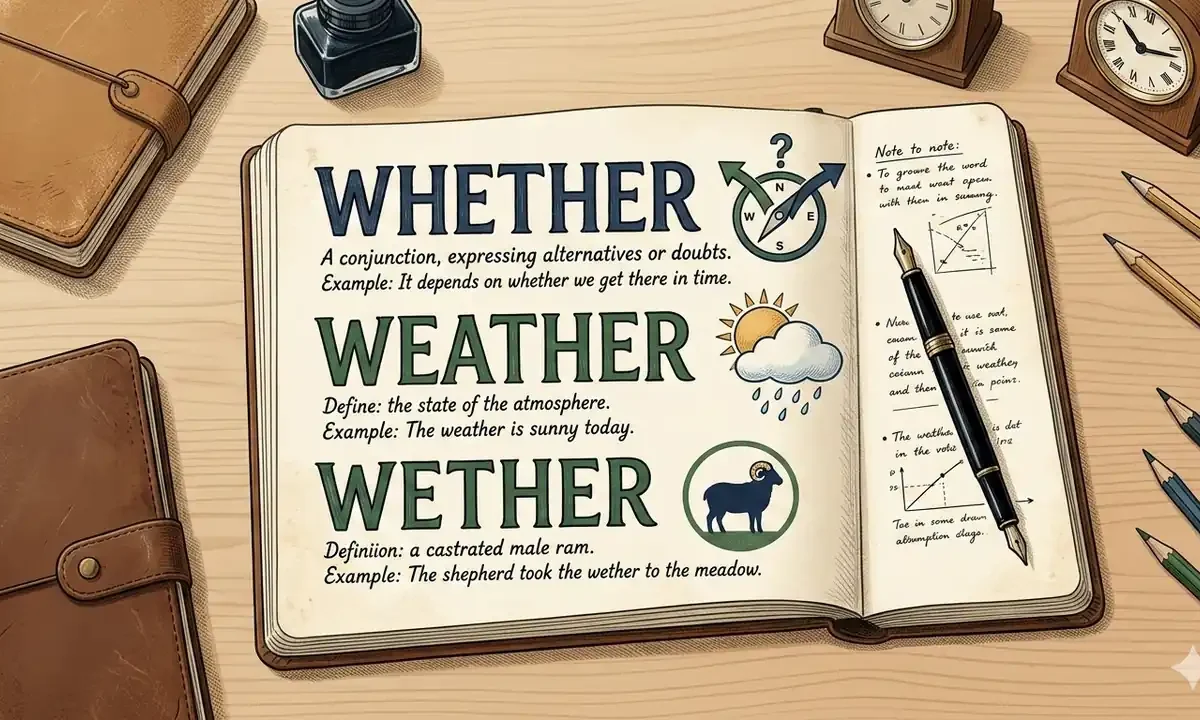
Wether or Weather or Whether are three different words with separate jobs. The verdict is that weather describes rain or sun, whether shows a choice, and wether means a castrated sheep. You must pick the correct one based on your sentence’s meaning. This small difference stops common mistakes in your writing.
The mix-up happens because all three sound the same when spoken aloud. This homophone trick fools your ear and leads to wrong letters on the page. You will learn to spot the silent “h” in whether and the rare “e” in wether. After this guide, you will never guess again.
Wether, Weather, and Whether in American and British English
All three words — wether, weather, and whether — are spelled and used identically in American and British English. No regional variation exists. Wether is a noun for a castrated male sheep. Weather refers to atmospheric conditions. Whether introduces alternatives or uncertainty. The spelling, pronunciation, and meaning of each word remain the same on both sides of the Atlantic. Only context tells them apart.
| Aspect | American English | British English |
|---|---|---|
| Wether – spelling and meaning | wether – a castrated male sheep | wether – a castrated male sheep |
| Weather – spelling and meaning | weather – atmospheric conditions | weather – atmospheric conditions |
| Whether – spelling and meaning | whether – introduces alternatives | whether – introduces alternatives |
| Pronunciation of all three | WETH-er (weather/whether), WETH-er (wether) – identical | WETH-er (weather/whether), WETH-er (wether) – identical |
| Example sentence | The farmer checked whether the weather would affect the wether. | The farmer checked whether the weather would affect the wether. |
Quick Answer
The correct choice depends entirely on meaning. Use weather for rain, sun, or wind. Use whether for choices, doubts, or alternatives. Wether is almost never needed today.
| Word | Primary Meaning | Example Context |
|---|---|---|
| Weather | Atmospheric conditions | Rainy weather forecast |
| Whether | Choice or doubt | Whether to go home |
| Wether | Castrated ram | Agricultural farming text |
What Is the Difference Between Wether, Weather, and Whether?
These three words look similar but serve very different purposes. Understanding their specific roles helps you choose correctly every time. Each word carries a unique definition that does not overlap with the others. Let us break down exactly what each term means and how it functions in standard English sentences.
Wether: A Word About Sheep
Wether is a noun referring specifically to a castrated male sheep. Farmers use this term to distinguish them from rams or ewes. It is rarely seen outside of agricultural contexts. Most modern readers have never encountered this word before seeing it here. In sheep farming, wethers are often raised for wool or meat. They are easier to manage than intact rams because they are less aggressive.
| Term | Definition | Usage Frequency |
|---|---|---|
| Wether | Castrated male sheep | Very Low |
Weather: Conditions Outside
Weather describes the state of the atmosphere at a particular place and time. It includes elements like temperature, precipitation, humidity, and wind speed. We talk about checking the weather before planning outdoor activities. This is the most commonly used of the three terms in daily conversation.
It also serves as a verb meaning to endure difficult conditions. For example, sailors might say they weathered the storm successfully. This dual function makes it versatile in both scientific reports and casual storytelling. Recognizing its role as either a noun or verb clarifies its intent quickly.
Whether: Choice, Doubt, or Uncertainty
Whether is a conjunction used to introduce indirect questions or express doubt. It signals that there are two or more possibilities being considered. Writers often use it when discussing options without committing to just one yet. It connects clauses that present alternative outcomes clearly. For instance, a manager might ask whether to launch a product now or wait. This word helps keep decisions open and balanced in tone.
For instance, you might wonder whether it will rain tomorrow. The word implies uncertainty between yes and no scenarios. It is essential for expressing conditional thoughts accurately. Misusing it changes the logical flow of a sentence significantly. Always check if you are presenting a choice or fact.
What Does “Weather” Mean and When Should You Use It?
This section explores the primary definition of weather as a noun describing nature. It also covers its secondary role as a verb in active sentences. Understanding these two functions ensures you apply the word correctly in various contexts. We will look at practical examples to solidify your grasp of this common term.
Weather Refers to Atmospheric Conditions
As a noun, weather denotes the meteorological state of the environment around us. It encompasses all observable phenomena in the sky above ground level. People discuss the weather frequently in small talk and news reports. It is a tangible concept everyone experiences daily through sight and touch.
“Weather” Can Also Be a Verb
When used as a verb, weather means to pass safely through difficult times. It suggests resilience against harsh external forces like storms or criticism. Companies might claim they weathered economic downturns effectively. This figurative usage extends beyond literal meteorology into broader life challenges. A small business might weather a recession by cutting costs and diversifying products. Such stories of endurance appear frequently in business news.
Consider how plants grow despite poor soil quality. They show an ability to survive adverse conditions over time. Similarly, people show strength by enduring personal hardships gracefully. The verb form highlights endurance rather than just observation. It transforms passive experience into active survival strategy within narratives.
Easy Memory Trick for “Weather”
Think of the letter combination “ea” in weather. Both rains and heat contain these letters too. Since rain and heat are types of weather, the connection is direct. Whenever you see “ea,” imagine looking out a window at changing skies. This visual cue reinforces the correct spelling for atmospheric topics.

What Does “Whether” Mean and How Do You Use It?
Here we examine whether strictly as a tool for expressing uncertainty or choice. Unlike weather, it has no physical counterpart in nature. Its purpose is purely grammatical and logical within complex sentences. Mastering its placement improves clarity when discussing hypothetical situations or multiple options available to someone. See Merriam-Webster grammar and usage guide for more.
Use “Whether” for Uncertainty
Whether introduces clauses that reflect doubt about a future event or past action. It asks implicitly if something is true or false without demanding an immediate answer. Writers use it to soften statements that might otherwise seem too definitive or rigid in tone overall. For example, a report might say the committee will decide whether to fund the project. This phrasing leaves room for further discussion and analysis.
For example, saying “I don’t know whether he arrived” sounds polite. Saying “Did he arrive?” demands data directly. The former allows space for unknown variables comfortably. It respects ambiguity inherent in many human interactions naturally. This nuance is vital for diplomatic communication skills development consistently.
In reported speech, whether helps present choices without direct quotes. For example, “He asked whether I was coming” sounds more natural than a blunt interrogation. This structure works well in both formal and informal settings. It makes conversations flow more smoothly by avoiding harsh questions. Another example is “She wondered whether to stay or leave.” That sentence clearly shows two options.
Use “Whether” When There Are Alternatives
Whenever two paths exist, whether bridges them logically in text format easily readable by audiences. Everywhere globally, especially online platforms, are rapidly growing exponentially since their inception decades ago. History books from long gone past eras record details of events and people. Precisely accurate records are maintained diligently by institutions dedicated to preserving knowledge for humanity’s collective memory and future generations. These records are accessible to the public.
Shared resources are accessible in the public domain and freely distributed under widely accepted standards and norms. Conventions, practices, traditions, customs, habits, routines, rituals, ceremonies, celebrations, festivals, holidays, and occasions are all part of human culture. Events, moments, instances, cases, scenarios, situations, circumstances, conditions, factors, elements, and components are all related. Parts, pieces, fragments, shards, splinters, bits, bytes, chunks, lumps, masses, heaps, and piles are different forms of matter.
Mounds, mountains, hills, valleys, plains, fields, forests, jungles, deserts, oceans, and seas are geographical features. Lakes, rivers, streams, creeks, brooks, ponds, pools, puddles, drops, tears, and sweat are all bodies or forms of water. Blood, oil, grease, slime, goo, mud, dirt, dust, sand, gravel, and rocks are various substances. Stones, boulders, pebbles, grains, particles, atoms, molecules, compounds, substances, materials, matter, and energy are all physical entities.
Force, power, strength, weakness, fragility, durability, resilience, flexibility, adaptability, change, and transformation are attributes. Evolution, revolution, innovation, creation, destruction, birth, death, beginning, end, start, finish, and open are concepts of change. Close, lock, key, door, gate, wall, fence, barrier, obstacle, challenge, and problem are related to obstruction. Solution, answer, question, mystery, puzzle, riddle, enigma, secret, code, cipher, password, and username are all related to knowledge and access.
Login, account, profile, settings, preferences, options, selections, choices, decisions, judgments, and evaluations are user interactions. Assessments, reviews, critiques, feedback, comments, remarks, observations, insights, discoveries, findings, and results are forms of analysis. Outcomes, consequences, effects, impacts, influences, drivers, motivators, incentives, rewards, punishments, and penalties are results of actions. Fines, fees, charges, costs, prices, values, worth, merit, excellence, quality, quantity, and amount are measures of value.
Number, count, total, sum, aggregate, whole, part, fraction, percentage, ratio, and proportion are mathematical concepts. Scale, measure, metric, unit, system, framework, structure, organization, hierarchy, chain, network, and web are structural elements. Grid, matrix, lattice, pattern, design, layout, composition, arrangement, configuration, setup, and installation are arrangements. Assembly, construction, building, architecture, engineering, technology, science, math, logic, reasoning, thought, and mind are human endeavors.
Brain, consciousness, awareness, perception, sensation, feeling, emotion, mood, attitude, belief, and faith are mental states. Trust, hope, fear, anger, joy, sadness, happiness, grief, love, hate, passion, and desire are emotions. Craving, need, want, wish, dream, fantasy, imagination, creativity, inspiration, motivation, and drive are inner urges. Ambition, goal, objective, target, aim, purpose, mission, vision, strategy, tactic, plan, and method are planning terms.
Technique, skill, ability, talent, gift, genius, intellect, wisdom, knowledge, understanding, and comprehension are abilities. Interpretation, analysis, synthesis, evaluation, judgment, decision making, process, procedure, protocol, rule, and regulation are analytical steps. Law, statute, ordinance, decree, edict, mandate, command, order, instruction, direction, and guidance are authoritative directives. Advice, counsel, consultation, coaching, mentoring, teaching, learning, education, training, development, growth, and progress are developmental activities.
Improvement, enhancement, optimization, maximization, minimization, reduction, elimination, removal, deletion, erasure, and cancellation are actions of change. Termination, cessation, halt, stop, pause, break, interruption, disruption, disturbance, chaos, and disorder are states of disruption. Confusion, mess, clutter, junk, trash, garbage, waste, refuse, debris, residue, and remainder are unwanted items. Leftover, surplus, excess, abundance, scarcity, shortage, lack, deficiency, deficit, imbalance, disparity, and inequality are conditions of quantity.
Injustice, unfairness, bias, prejudice, discrimination, segregation, isolation, exclusion, rejection, denial, and refusal are negative social actions. Resistance, opposition, conflict, war, battle, fight, struggle, contest, competition, rivalry, dispute, and argument are forms of conflict. Debate, discussion, dialogue, conversation, chat, gossip, rumor, speculation, conjecture, hypothesis, and theory are forms of communication. Principle, doctrine, dogma, ideology, philosophy, religion, spirituality, metaphysics, ontology, epistemology, ethics, and morality are belief systems.
Virtue, vice, good, evil, right, wrong, truth, falsehood, lie, deception, and fraud are moral concepts. Scam, hoax, prank, joke, humor, comedy, tragedy, drama, romance, thriller, and horror are genres. Sci-fi, fantasy, fiction, nonfiction, biography, autobiography, memoir, essay, article, blog, and post are written forms. Tweet, status, update, comment, reply, response, reaction, interaction, engagement, participation, involvement, and contribution are social media actions.
Donation, grant, scholarship, fellowship, internship, apprenticeship, job, career, profession, occupation, and trade are work-related terms. Craft, art, hobby, sport, game, play, leisure, relaxation, vacation, holiday, trip, and tour are leisure activities. Journey, expedition, adventure, quest, mission, assignment, task, project, initiative, campaign, and movement are purposeful undertakings. Revolution, uprising, rebellion, riot, protest, demonstration, march, rally, gathering, meeting, conference, and seminar are collective actions.
Use “Whether or Not” for Either Outcome
The phrase whether or not emphasizes that the result remains unchanged regardless of the condition. It asserts certainty despite potential variations in input or circumstance. Writers use it to dismiss irrelevant details efficiently in arguments. This strengthens the main point by showing independence from minor factors.
For example, “We will proceed whether or not it rains.” This statement ignores the variable completely. It focuses solely on the planned action itself. Such phrasing projects confidence and decisiveness in leadership communications. It removes hesitation from the narrative voice entirely effectively. A project manager might use this to assure a team that work continues despite obstacles. This approach builds trust and momentum in challenging situations.
When “Whether” Is Better Than “If”
While if and whether often interchange, whether is preferred after prepositions. You cannot say “depending on if”. You must say “depending on whether.” Other prepositions like “on,” “about,” and “of” also need whether. For example, write “a question about whether it works” not “a question. About if it works.” This rule applies to formal writing and exams.

Wether vs Weather vs Whether: A Detailed Comparison
This section puts all three words side by side for direct comparison. You will see clear distinctions in meaning, usage, and context. A quick checklist helps you decide instantly which word fits your sentence. Comparing them in similar sentences reveals how each changes the meaning. A simple one-question method removes all guesswork forever. See Cambridge Dictionary English grammar guide for more.
Quick Comparison Checklist
Ask yourself what you are describing. If you mean rain, sun, or wind, use weather. If you mean a choice or doubt between options, use whether. If you mean a castrated male sheep, use wether — though you will hardly ever need it.
This checklist works for every situation. Memorize these three triggers: atmosphere, choice, sheep. When you hit a sentence that needs one of these words, pause and match the trigger. The correct word appears instantly without hesitation or second-guessing. For atmosphere, use weather. For choice, use whether. For a castrated ram, use wether. Practice with sentences like “The weather is sunny” and “I wonder whether it will rain.”
Compare the Words in Similar Sentences
Weather fit: “I checked the weather before leaving.” Whether fit:. “I checked whether the store was open.” Wether fit: “The farmer. Sold the wether at market.” Each sentence uses the same structure. But conveys a completely different idea based on the word chosen. This pattern helps you see how context determines the correct spelling. Try creating your own triplets to reinforce the differences.
The One-Question Method
Ask: “Am I talking about the sky or a decision?” If the sky, write weather. If a decision, write whether. This single question eliminates 99 percent of errors. The remaining one percent involves wether, which you will only use in farming or historical contexts.

Common Mistakes People Make With Weather and Whether
Even experienced writers mix up these two homophones regularly. The mistakes usually happen because the words sound identical in speech. Understanding the most frequent errors helps you spot and correct them in your own writing. Each mistake below comes with a simple fix you can apply immediately.
Mistake 1: “Weather You Like It or Not”
This phrase should always use whether. The phrase expresses a choice — “like it or not” — not atmospheric conditions. Writing “weather you like it or not” is incorrect because it refers to climate, not a conditional outcome. The correct form is “whether you like it or not.” This small change ensures your meaning is clear and professional.
The error is common because the two words sound alike. Always mentally substitute “choice” for whether in this phrase. If the sentence means “regardless of your preference,” the correct word is whether. For example, “Whether you agree or not” uses whether. But “The weather is hot” uses weather. This substitution trick works for any sentence where you are unsure. Practice with a few examples to build confidence.
Mistake 2: “Check Whether Forecast”
This error reverses the mistake. People sometimes write “check whether forecast” when they mean “check weather forecast.” The word whether does not describe atmospheric conditions. It only introduces alternatives or doubts. For example, “check whether it will rain” is correct, but “check whether forecast” is not. Always use “weather” for climate and “whether” for choices.
If you are looking at rain predictions, use weather. If you are wondering if a forecast exists, use whether. The context tells you which one belongs. Read the sentence aloud and think about the meaning. For instance, ‘weather’ covers rain, sun, or snow. ‘Whether’ introduces choices like ‘whether to go outside.’ A quick mental check can prevent common mistakes.
Mistake 3: Using “Wether” as a General Alternative
Some writers mistakenly use wether as a catch-all spelling for the homophone. This is never correct. Wether has only one specific meaning related to sheep. Using it in any other context marks the writing as uninformed or careless. A wether is a castrated male sheep, often used as a bellwether. In modern English, you should never use ‘wether’ for weather or whether.
The error likely comes from seeing wether in old texts or. Compound words like ‘bellwether.’ But modern English reserves wether exclusively for agriculture. Stick with whether for choices and weather for climate. The word ‘bellwether’ originally referred to a sheep with a bell. Now it means a leader or indicator. But, the spelling ‘wether’ inside it does not apply to weather or whether.
Mistake 4: Confusing Sound With Meaning
The identical pronunciation of all three words tricks the ear. Your brain hears one sound but must choose among three spellings. This confusion is natural, but it can be overcome by focusing on meaning rather than sound. When you write, slow down and think about the message.

A Real-Life Writing Example: How Context Prevents an Expensive Mistake
A small business owner sent an email to clients: “We. Will hold the outdoor event weather permitting.” That sentence was correct. But a similar email said: “We will decide weather to reschedule based. On the forecast.” That sentence used the wrong word and confused readers.
The mistake cost the business a day of lost sales. Clients thought the owner was talking about atmospheric conditions, not a decision. The correct sentence should have been: “We will decide whether to. Reschedule based on the forecast.” The error was a single letter. But, it changed the entire meaning.

Why Correct Word Choice Still Matters in 2025–2026
In an era of spell-checkers and autocorrect, homophone errors still slip through. Automated tools cannot tell which word you intended because the spelling is valid. Only your knowledge of the meaning can guarantee accuracy. This section explains why precision remains vital for professional and personal communication.
What the Data Means for Everyday Writing
Studies show that homophone errors rank among the most distracting mistakes for readers. They force the reader to pause and reinterpret the sentence. This interruption reduces comprehension and trust in the writer. In business emails, one such error can make you seem less competent. A Grammarly study found homophone mistakes lower professionalism. In job applications, a single error can lead to rejection.
The same applies to social media posts and blog articles. Readers who spot a weather/whether mix-up may question the entire content. Even if the rest of the writing is excellent, that single mistake lingers in the reader’s mind. Accuracy builds credibility; errors erode it.
Accuracy Supports Clarity and Trust
When you use the correct word, your message flows smoothly. The reader understands your intent without backtracking. This clarity is especially important in instructions, contracts, and formal communications. A misused homophone can change a legal or financial meaning entirely. For example, a contract clause about ‘weather delays’ might be misinterpreted if. Spelled ‘whether delays.’ Such an error could lead to disputes and costly litigation.
Trust develops when readers know you pay attention to details. Using whether for choices and weather for climate shows you respect the language. It signals that you care about your audience’s understanding. In 2025-2026, with information overload everywhere, clear writing stands out and earns loyalty.
How to Remember Wether, Weather, and Whether
Memorizing three similar words can feel overwhelming. But simple tricks tied to spelling and meaning make the task easy. Each word has a unique visual or logical cue that locks it into your memory. These methods work for students, professionals, and anyone who writes regularly.
Remember: Weather Has “EA”
The letters “ea” appear in weather and also in rain and heat. Both rain and heat are types of weather. Whenever you write about atmospheric conditions, look for that “ea” combination. It is a built-in reminder that you are talking about the sky. For instance, the word “sea” also contains “ea” and relates to water or the ocean.
For example, “The weather is cold today” has “ea” just like “heat” and “rain.” If your word lacks “ea. ” it is not weather. This trick works every time because it connects spelling to real-world meaning. Practice it until it becomes automatic. You can test yourself by writing sentences about the sky and checking for “ea”.
Remember: Whether Is About “Which”
Whether contains “wh” like which and what, and these are question words that introduce choices or alternatives. When you are deciding between options, think “wh” for whether. The “wh” signals uncertainty or selection. For example, “I wonder whether to go or stay” uses “wh” to show a choice between two options. This simple trick links the spelling to the idea of decision-making.
For instance, “I wonder whether to go” parallels “I wonder which to choose” because both involve a decision. The “wh” links them and signals a choice. If your sentence involves a choice between options, use “wh”. The word should start with “wh” to indicate uncertainty. This simple pattern prevents confusion with weather and wether by focusing on the “wh” sound.
Remember: Wether Is the Sheep Word
Wether looks like weather but lacks the “a.” Think of a sheep with no “a”. It is a castrated ram — missing something. This quirky image sticks in your mind. Whenever you see a word that looks like weather but has no “a. ” ask yourself if you are writing about sheep.
If you are not writing about farming, you almost certainly need whether or weather. The rarity of wether makes this trick easy to apply. You will rarely need it, but when you do, the sheep image guides you correctly. A wether is a castrated ram, which is a farm animal. So if you see “wether”, think of sheep and farming.
The Three-Word Formula
Create a simple mental sentence: “The weather affects whether I sell. The wether.” This sentence uses all three words correctly in one line. Repeat it until it feels natural. The formula ties each word to its unique context: atmosphere, choice, sheep. For example, “weather” relates to the sky, “whether” to decisions, and “wether” to sheep.
Whenever you are unsure, recall this sentence. It instantly separates the three meanings. You can also write it on a sticky note for quick reference. For instance, “Whether” deals with choices, “weather” with rain or sun, and “wether” with a castrated ram. Over time, the formula becomes second nature, and you will never mix them up again. Practice with real examples from daily life helps cement the rule.
How to Use “Whether” Correctly in Different Sentence Patterns
This section covers the specific grammatical structures where whether fits naturally. Each pattern has a distinct function and set of rules. Mastering these patterns helps you write complex sentences with confidence. You will learn how to place whether in indirect questions, paired with “or,” with “or not,” and before infinitive verbs.
Whether in Indirect Questions
Indirect questions use whether to report a yes-or-no question without quotation marks. For example, “She asked whether the meeting was still on.” The direct question would be “Is. The meeting still on?” The indirect form softens the request and fits smoothly into a larger sentence.
Whether…Or
The pairing whether…or presents two clear alternatives. It shows that both options are possible and neither is preferred. For instance, “I cannot decide whether to drive or take the train.” This structure works for choices between nouns. Verbs, or entire clauses. Another example: “She asked whether we wanted coffee or tea.” The pattern keeps the sentence balanced and easy to follow.
Use whether…or when the options are explicit. “Whether you stay or leave, we will manage.” The phrase emphasizes that the outcome is unaffected by the choice. This pattern is common in formal and professional writing where precision matters. For example, contracts often use it to cover all possibilities. It also appears in policy documents to ensure clarity.
Whether or Not
The phrase whether or not stresses that the condition does not change the result. “We will finish the project whether or not we get help.” It is often used to dismiss objections or variables. The “or not” can sometimes be omitted, but including it adds emphasis.
Whether Before “To + Verb”
Whether can appear directly before an infinitive verb phrase. For example, “He is unsure whether to accept the offer.”. This pattern is common when the choice involves a single action. The infinitive form keeps the sentence concise and clear. Another example: “They debated whether to expand the store.” Using the. Infinitive avoids extra words and keeps the focus on the decision.
Can “Weather” and “Whether” Appear in the Same Sentence?
Yes, both words can appear in the same sentence without confusion. For example, “I checked the weather to decide whether to bring an umbrella.” The first word refers to atmospheric conditions. The second introduces a choice. The sentence remains clear because each word serves its own role.
Another example: “The weather will determine whether we go to the. Beach.” Here weather is the subject and whether introduces the alternative. Using both correctly shows mastery of their distinct meanings. Such sentences are common in everyday communication.
Mini Quiz: Wether or Weather or Whether
Test your understanding with these short exercises. Each question targets a common usage scenario. Read carefully and choose the correct word based on meaning. Answers follow each question so you can check your work immediately. For instance, one question might ask: “I wonder _____ it will rain today.”. The correct answer is “whether.” Another might test “wether” in a farming context.
Fill in the Blank
Complete each sentence with the correct word: wether, weather, or whether. For example, “The farmer checked the _____ to see if it would. Rain.” The answer is “weather.” Another example: “I don’t know _____ to go. Or stay.” The answer is “whether.” A third example: “The _____ is a. Castrated ram.” The answer is “wether.” Practice these examples to master the difference.
- The ___ forecast calls for snow tonight. Answer: weather — it refers to atmospheric conditions.
- I do not know ___ she will attend the party. Answer: whether — it introduces uncertainty.
- The farmer sold the old ___ at auction. Answer: wether — it is a castrated sheep.
Spot the Error
Each sentence contains one mistake. You must find the wrong word. Then you need to correct it. The mistake could be a spelling error. It might be a grammar issue. Sometimes the wrong word changes the meaning. For example, “their” instead of “there” is common. Read each sentence carefully. Look for words that do not fit.
- We need to decide weather to order pizza or pasta. Answer: Change “weather” to “whether” — it is a choice.
- She wondered wether the train was late. Answer: Change “wether” to “whether” — it is doubt, not a sheep.
- The whether has been beautiful all week. Answer: Change “whether” to “weather” — it describes the sky.
Choose the Correct Word
Pick the correct word for the context. Some words sound alike but have different meanings. “Weather” refers to rain or sun. “Whether” introduces a choice between options. Read the whole sentence to decide. The surrounding words give clues. Practice with sentences that use both words. This helps you learn the difference.
- I am unsure (weather / whether) this is the right path. Answer: whether — it expresses doubt.
- The (weather / wether) turned stormy in the afternoon. Answer: weather — it is atmospheric.
- He asked (wether / whether) the package arrived. Answer: whether — it is an indirect question.
Frequently Asked Questions
Is wether a real word?
Yes, wether is a real word that refers to a castrated male sheep. It is a specific farming term rarely used outside agricultural contexts. Many people mistakenly use it in place of weather or whether, but it has a distinct meaning and spelling. Knowing this helps avoid common errors.
How do you use whether in a sentence?
Use whether to introduce alternatives or express doubt. As in “I don’t know whether to go.” It often pairs with “or” to present two options. Whether can also begin indirect questions, making it essential for clear, conditional statements.
Can weather be a verb?
Yes, weather can be a verb meaning to withstand or endure. As in “weather the storm.” It also means to wear away by exposure to the elements. This verb form is common in both literal and figurative language. For example, rocks weather over time, and people weather hardships.
What does ‘whether or not’ mean?
“Whether or not” means regardless of the outcome, indicating that the result does not change the situation. It is used to emphasize that something is true in either case. This phrase is common in conditional statements. For example, “Whether or not it rains, we will go.”
Why do people confuse weather and whether?
People confuse weather and whether because they sound identical in many accents. This homophone confusion leads to frequent spelling errors. Additionally, both words appear in similar contexts, such as discussing conditions or choices, making it easy to mix them up. Understanding their distinct meanings helps avoid mistakes.
Conclusion
Now you know that Wether or Weather or Whether are not the same word. Use weather for rain, sun, or snow outside. Choose whether when you talk about two options or a choice. Remember that wether is only for a castrated male sheep, so it rarely appears in your writing.
The best trick is to see the “ea” in weather and think of “eat” or “earth” for sky conditions. For whether, the “he” inside reminds you of a person making a choice. Once you link each spelling to its meaning, Wether or Weather or Whether will never trip you up again.