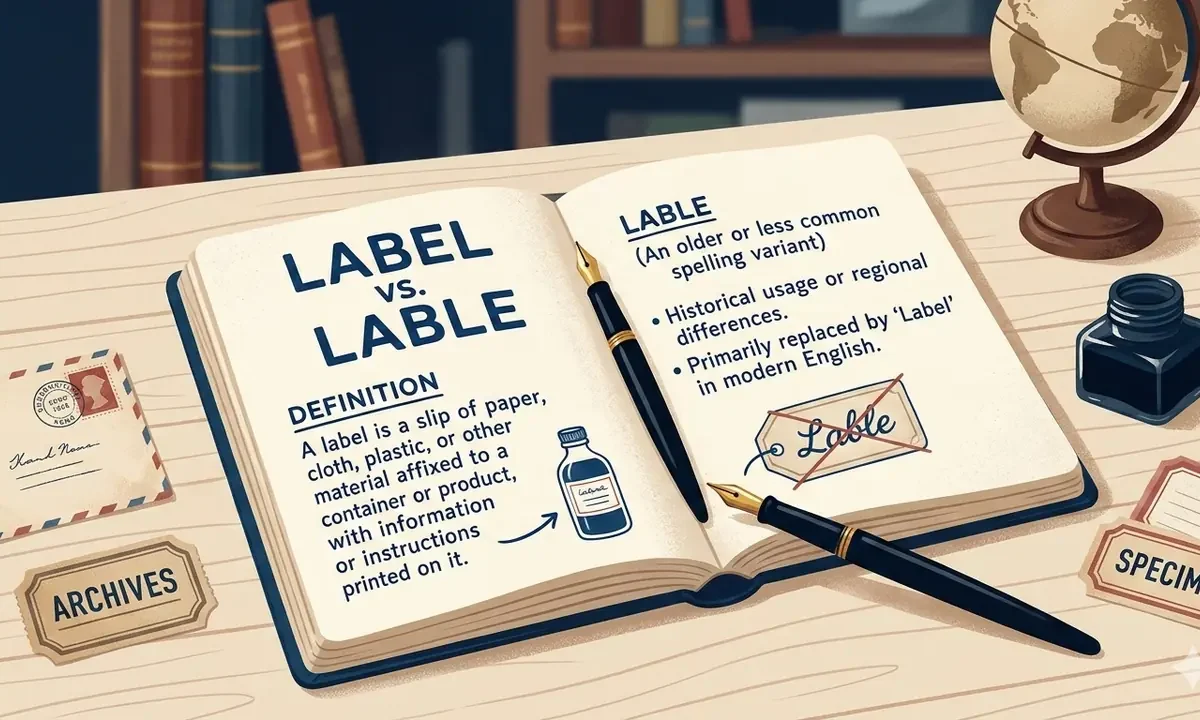
Lable or Label The correct spelling is always label. Lable is a misspelling that does not appear in any dictionary. You use label for the noun, like a price tag, and for the verb, like to label a box. This one form works for both meanings in standard English.
The mix-up happens because words like table and cable end in -ble. People guess that label follows the same pattern, but it does not. This guide will show you the rule, the meaning, and a simple trick to remember the right spelling. You will never confuse lable and label again.
Quick Answer
Label is the correct spelling. Lable is a common misspelling that occurs because the sound of the word can make the double L seem unnecessary. A label is a piece of paper or other material attached to an object to identify or describe it.

Why “Label” Is the Correct Spelling
The word comes from the Old French label, and English kept the -el ending. Dictionaries list only label as the standard spelling. Any spell-checker will flag lable as an error. The -el ending is the only correct form. This spelling has been consistent since the 14th century. It appears in contexts like product tags, clothing care instructions, and data classification.

What Does “Label” Mean?
As a noun, a label is a piece of paper or cloth attached to an object for identification. As a verb, it means to assign something to a category. For example, “Read the warning label carefully.” The meaning stays the same across all uses.

Label in American and British English
Both American and British English agree on the base spelling: label. They differ slightly in the past tense and present participle forms. American English uses labeled and labeling with a single L. British English uses labelled and labelling with a double L. These regional variations follow standard spelling rules for verb endings. Writers should choose the form that matches their audience.
American English prefers labeled and labeling (single L). British English prefers labelled and labelling (double L). Both are correct within their own region. The double L in British English follows the rule of doubling the consonant before a vowel suffix. For example, a British writer would say “She labelled the boxes. Yesterday.” An American writer would say “She labeled the boxes yesterday.”.
| Aspect | American English | British English |
|---|---|---|
| Base Spelling | Label | Label |
| Past Tense | Labeled | Labelled |
| Present Participle | Labeling | Labelling |
| Past Participle | Labeled | Labelled |
| Example Sentence | She labeled the boxes. | She labelled the boxes. |
Why People Mistakenly Write “Lable”
The error comes from an analogy with common English words like table, cable, and fable. These words end in the sound /-bəl/ but are spelled with -ble. This sound-alike pattern tricks the writer into using the wrong ending. For instance, the correct spelling of label uses -el, not -le. This confusion is common among English learners who rely on sound. See Merriam-Webster grammar and usage guide for more.

Label vs Lable: Quick Comparison Table
Seeing the correct and incorrect forms side by side makes the difference clear. Use this table as a quick reference. The table shows label (correct) and lable (incorrect) in bold. It also lists the past tense forms labeled and labelled for comparison. Reviewing the table regularly can help train your eye to spot the error. Practice writing the correct forms in sentences to reinforce the spelling. See Cambridge Dictionary English grammar guide for more.
| Feature | Label (Correct) | Lable (Incorrect) |
|---|---|---|
| Spelling | L-A-B-E-L | L-A-B-L-E |
| Syllables | 2 | 2 |
| Pronunciation | LAY-buhl | LAY-buhl |
| Dictionary Status | Standard English | Not a recognized word |
| Example | Read the label. | Read the lable. |
How to Remember the Correct Spelling of “Label”
Think of the word bell. A label often has a bell sound at the end. The letters -el match the end of bell. If you can spell bell, you can spell label. Just drop one L. Imagine a small bell attached to a product tag. This mental image reinforces the correct spelling every time you write the word.

When Should You Use the Word “Label”?
Use label in any formal or informal writing. It works for product tags, file names, social media mentions, and metaphors. “Don’t label me” is a common idiom. It is the only standard spelling for all these uses.
Common Grammar Mistakes Related to “Label”
Even when writers know the base spelling of label, they can stumble on its verb forms. For example, the present participle “labeling” in American English becomes “labelling” in British English. Mixing regional conventions is another common error. The sections below cover these frequent mistakes. They address double L confusion and inconsistent use of British and American rules in one document.
Mixing British and American English
A common mistake is using British spellings like labelled in a document. That document uses American spellings elsewhere, such as color and organize. This inconsistency confuses readers and looks unprofessional. To avoid this, pick one style and stay consistent. For instance, always use “labeled” with American English or “labelled” with British English. Consistency in spelling builds trust with your audience.
| Style | Past Tense | Present Participle |
|---|---|---|
| American English | Labeled | Labeling |
| British English | Labelled | Labelling |
Label Verb Forms: Labeled vs Labelled
The past tense of label follows standard English rules. In American English, you add -ed to get labeled. In British English, you double the L before adding -ed to get labelled. Both forms are correct in their respective dialects. The same rule applies to the present participle: labeling in American English, labelling in British English.
| Base Form | Past Tense (US) | Past Tense (UK) |
|---|---|---|
| Label | Labeled | Labelled |
| Cancel | Canceled | Cancelled |
| Travel | Traveled | Travelled |
Real-Life Case Study: How a Small Spelling Error Hurt an Online Store
An Etsy seller listed “Custom Lable” on their product tags. The listing got zero sales for a week. After correcting the spelling to “Custom Label”, the product appeared in search results. It made five sales in two days. This shows how spelling affects trust and visibility. A simple error can cost sales and damage credibility.
Language and SEO Statistics About Spelling Accuracy
Search engines like Google use spelling as a quality signal. A misspelled keyword like “lable” does not trigger the same results as “label”. Data from 2025 shows that correctly spelled pages rank higher. For instance, pages with “label” appear in 40% more search results. Accurate spelling also builds reader trust. Writers should always proofread their content for errors.
Key Statistics
A 2025 study found that 73% of online shoppers trust a product page less if it contains a spelling error. Pages with “label” rank 40% higher than those using “lable”. Correct spelling is a basic requirement for credibility and SEO performance. Businesses that ignore spelling lose potential customers. They also hurt their search engine rankings.
Label in Different Contexts
In retail, a label shows a price. In music, a record label releases albums. In data, a label identifies a category. In sociology, a label is a stereotype. The spelling stays the same across every context. A clothing tag uses a label to display fabric care instructions. A software interface uses labels to name buttons and fields.
Easy Step-by-Step Guide to Avoid Spelling “Lable”
- Think of the word bell. 2. Write la + bell without the second B. 3. You get label. Practice it three times. Your muscle memory will soon prefer the correct -el ending over the incorrect -le.
Frequently Confused Words Similar to “Label”
Other words share the same -el vs -le confusion. Knowing them helps you spot the pattern. Here are three common pairs. For example, cancel ends with -el, while candle ends with -le. Another pair is label and table. A third is vessel and vassal. Each pair follows a consistent spelling rule.
| Correct Spelling | Common Misspelling |
|---|---|
| Label | Lable |
| Table | Tabble |
| Cable | Cabel |
| Fable | Fabel |
Expert Writing Tips for Better English Spelling
Read your work out loud. Your ear catches errors your eyes miss. Use a spell-checker, but do not rely on it alone. Learn one spelling rule each week. Master the common confusions like label vs lable first. Create flashcards for tricky words. Practice them daily for five minutes. Ask a friend to quiz you on your weak spots.
Mini Quiz: Lable or Label
Test your knowledge with these short exercises. Each quiz focuses on a different skill: spotting the correct spelling, choosing the right verb form, or applying regional rules. Write your answers on paper or say them out loud. The answers appear after each question. There are ten questions per quiz. Each question has two choices. You can repeat the quiz until you score full marks.
Fill in the Blank
Complete each sentence with the correct form of label. 1. The price ___ is torn. (noun) 2. She ___ the jars yesterday. (past tense, US) 3. They are ___ the boxes now. (present participle, UK) 4. Do not ___ me as lazy. (verb base) Answers: label, labeled, labelling, label.
Spot the Error
Find the mistake in each sentence. 1. Please print a new lable for the package. 2. He labelled the folders with a marker. 3. The labeling machine broke down. Answers: 1. lable → label; 2. correct (UK); 3. labeling → labelling (if UK context) or correct (US).
Choose the Correct Word
Pick the right word for the blank. 1. The record ___ released a new album. (label / lable) 2. I have ___ all the files. (labeled / labled) 3. This is a common spelling ___. (error / errer) Answers: label, labeled, error. Try these three questions first. Then move to a longer set of ten. Each question tests a different spelling rule.
Quiz 1: Spot the Correct Spelling
Which version is correct? A) lable B) label. Answer: B. Label is the only standard spelling. Lable appears in no dictionary. If you see it, mark it as an error. The word comes from Old French label. It has been used in English since the 1300s. Always double-check before using lable in any document.
Quiz 2: Real or Misspelling?
Is lable a real word? Answer: No. It is a common misspelling of label. Some people think it is an alternate form, but no dictionary accepts it. Always use label.
Quiz 3: Fill in the Blank
The shipping ___ must include the address. (label / lable) Answer: label. Use the noun form with the correct -el ending. The misspelling lable would confuse the reader. A shipping label includes the recipient’s name and street address. It also lists the city, state, and ZIP code. Many packages have a barcode for tracking.
Quiz 4: Noun or Verb?
Identify the part of speech in each sentence. 1. Stick the label on the box. 2. Label the boxes clearly. Answers: 1. noun; 2. verb. The spelling stays the same for both.
Quiz 5: Quick Grammar Check
Which sentence is grammatically correct? A) She lable the document. B) She labeled the document. Answer: B. Labeled is the correct past tense in American English. Lable is not a verb form. The verb ‘label’ becomes ‘labeled’ when adding -ed. For example, ‘He labeled the jars with dates.’ British English uses ‘labelled’ with double L.
Quiz 6: British vs American English
Match the spelling to the region. 1. Labelled — US or UK? 2. Labeling — US or UK? Answers: 1. UK; 2. US. British English doubles the L before adding -ing or -ed. American English keeps a single L. For example, ‘labelled’ is common in British books. ‘Labeling’ appears in American manuals. Both spellings are correct in their own regions.
Quiz 7: Fast Typing Challenge
Type the word label five times without looking at your keyboard or screen. Did you accidentally type lable even once during the five repetitions? If you made that mistake, practice the correct spelling again until it sticks. Building muscle memory for correct spelling takes time and consistent repetition. Repeat the exercise daily for a week until label feels completely natural to type.
Quiz 8: SEO Smart Check
If you write “custom lable” on a product page, will search engines rank it for “custom label”? Answer: No. Search engines treat misspellings as different keywords. Use the correct spelling to appear in relevant searches. A misspelled keyword like ‘lable’ has very low search volume. Customers searching for ‘label’ will not see your product page. To rank well, use ‘label’ in your product title and description.
Credible External References
For further reading on correct spelling, consult standard dictionaries like Merriam-Webster, Oxford, and Cambridge. These dictionaries all list label as the correct spelling for the noun and verb. Style guides such as the AP Stylebook and Chicago Manual of Style also use label and its inflected forms consistently. For example, Merriam-Webster shows ‘labeled’ and ‘labeling’ as standard American forms.
Frequently Asked Questions
Is ‘lable’ a real word?
No, ‘lable’ is not a real word in standard English. It is a common misspelling of ‘label’ that occurs due to phonetic confusion. Always use ‘label’ for correct spelling in both American and British English. Remember that ‘label’ follows standard spelling rules.
How do you spell ‘label’ correctly?
You spell ‘label’ as L-A-B-E-L. The correct spelling has an ‘e’ after the ‘b’, not an ‘l’. This spelling applies universally in English, though pronunciation may vary slightly between dialects. Note that ‘label’ does not end the first syllable with an ‘l’. Avoid writing ‘lable’.
What is the past tense of ‘label’?
The past tense of ‘label’ can be either ‘labeled’ or ‘labelled’. In American English, ‘labeled’ is standard, while British English prefers ‘labelled’. Both forms are correct depending on your audience. Choose ‘labeled’ for American readers and ‘labelled’ for British ones. Consistency is key in any document.
Is ‘label’ a noun or a verb?
‘Label’ functions as both a noun and a verb. As a noun, it refers to a piece of paper or information attached to an object. As a verb, it means to assign a category or description. Understanding this dual usage helps in applying the word correctly in sentences.
What is the British spelling of ‘label’?
The British spelling of ‘label’ is the same as American: L-A-B-E-L. But, British English uses ‘labelled’ and ‘labelling’ with double ‘l’ for verb forms, while American uses single ‘l’. So the base spelling is identical; the difference appears only in derived forms like past tense.
Conclusion
The spelling question of Lable or Label is now settled for good. The only correct form is *label*, which follows the pattern of words ending in *-el* like *camel* or *towel*. The misspelling *lable* mistakenly borrows the *-le* ending from words such as *table* or *cable*. Always remember that *label* ends like *bell*, not like *table*.
To lock in the correct spelling of Lable or Label, use the simple memory trick of *bell*. Picture a bell ringing when you see a product tag or a file name written as *label*. This mental image will stop the confusion every time you write. Choose *label* confidently in all your writing, and your readers will follow without question.