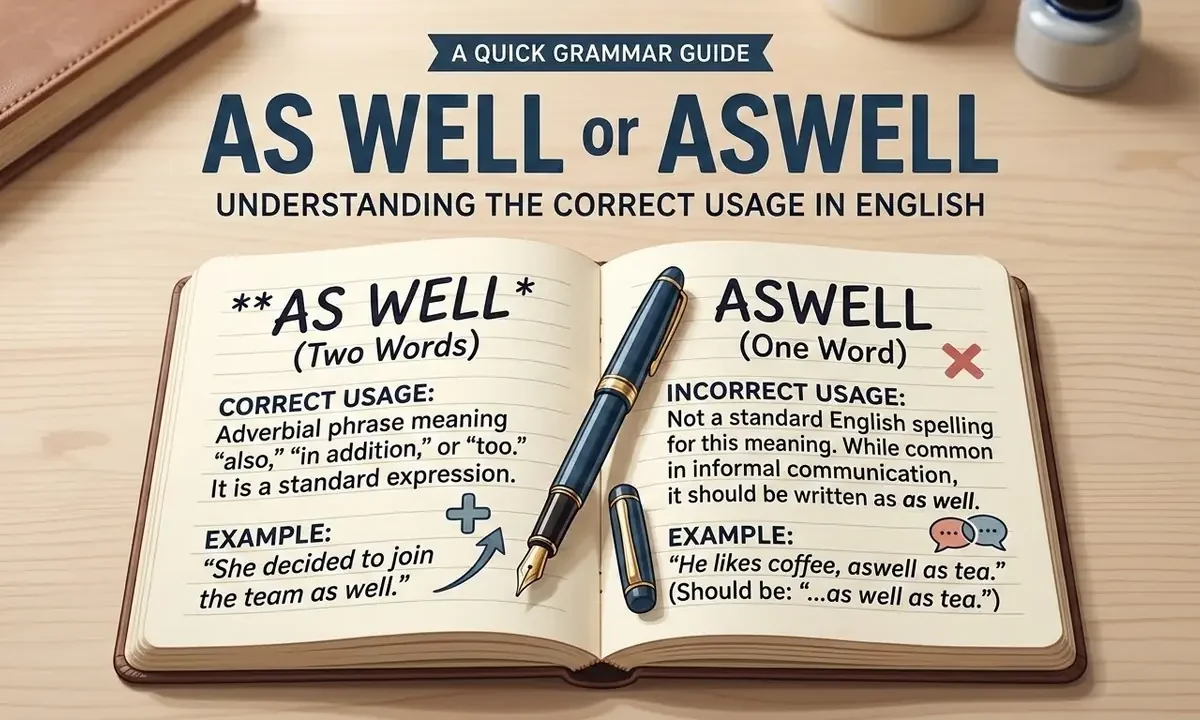
As Well or Aswell has a clear answer: the correct form is always as well, two separate words. Aswell is a misspelling that no dictionary accepts. If you write it as one word, you are making a spelling error. This rule never changes, so you can rely on it every time.
People mix them up because they hear the phrase pronounced as one smooth sound. Like “uh-swell.” The letter pattern that causes the error is the missing space between as and well. This guide will show you why as well stays separate and how to use it correctly. You will also learn a simple trick to never write aswell again.
Quick Answer
Always write as well as two words. Aswell is not a word in standard English. The phrase means “in addition” or “also.” Use it at the. End of a sentence or clause: “I’ll have coffee as well.”.
| Correct | Incorrect |
|---|---|
| as well | aswell |
What Does “As Well” Mean?
As well is an adverb phrase meaning “in addition,” “also,” or “too.” It adds something extra to a statement. For example: “She sings. She dances as well.” The phrase always appears after the verb or at the end of a clause.

Is “Aswell” a Real Word?
No. Aswell does not appear in any standard dictionary. It is a misspelling caused by hearing the two words run together in speech. Writers sometimes treat it like “also,” which is one word, but as well never merges. Always keep it separate.

As Well vs Aswell: The Main Difference
The difference is simple: one form is correct, the other is an error. This section explains why as well stays two words and gives you a clear rule to follow. Understanding the reason will help you avoid the mistake for good. For instance, many writers mistakenly write “aswell” in emails and reports. That single-word version is never accepted in standard English. Memorizing the rule saves you from common grammar checks.
Why “As Well” Stays Separate
As well is a phrase made of two distinct words: the preposition as and the adverb well. Each word keeps its own meaning. English does not combine them into a single word, unlike “also” which came from “all so.” The space is essential. Think of similar phrases like “as much” or “as often.” They also remain two words. This pattern helps you remember the correct spelling.
| Aspect | As Well (Correct) | Aswell (Incorrect) |
|---|---|---|
| Spelling | Two separate words | One combined word |
How to Use “As Well” Correctly in Sentences
Using as well correctly means placing it at the end of a clause or sentence. It adds information without changing the sentence structure. This section shows you how to use it in both formal and everyday writing. For example, “She brought dessert as well.” You can also use it after a verb phrase. “He enjoys hiking as well.” Avoid putting it in the middle of a sentence. See Merriam-Webster grammar and usage guide for more.
Use “As Well” in Formal Writing
As well is perfectly acceptable in formal writing. Use it to add an item or idea without sounding casual. Example: “The report covers sales figures as well.” Avoid using “too” in very formal contexts. as well is a safe choice. Another example: “The study includes demographic data as well.” It works in academic papers and business documents. This phrase maintains a professional tone.

Common Grammar Mistakes Related to “As Well”
Writers often confuse as well with similar words like “also” and “too.” They also misuse its position in a sentence. This section covers the most frequent errors and how to fix them. One common mistake is writing “aswell” as one word. Another is placing it before the verb, like “He as well came.” The correct position is at the end. Practice these corrections to improve your writing. See Cambridge Dictionary English grammar guide for more.
Confusing It With “Also” and “Too”
Many people use “also,” “too,” and as well interchangeably, but they have different positions. “Also” usually goes before the verb. “Too” and as well go at the end. Example: “He also plays guitar.” vs. “He plays guitar as well.” The table below shows the difference.
| Word | Position in Sentence |
|---|---|
| Also | Before the main verb |
| Too | At the end of a clause |
“As Well” in American and British English
Both American and British English spell as well as two words. There is no regional difference. But, usage frequency varies slightly. This section explains how each variety treats the phrase. In American English, “as well” appears more in formal writing. British English uses it more in everyday speech. For example, a British speaker might say “I’ll have tea as well.” An American might say “I’ll have tea too.”
British English
In British English, as well is very common in both speech and writing. It often replaces “too” in formal contexts. For example, “I’ll have tea as well.” British writers rarely use “aswell”. The misspelling is equally wrong on both sides of the Atlantic. Many style guides recommend keeping the two words separate. The error appears in informal online posts but is corrected in published works.
American English
American English uses as well frequently, especially in formal or professional writing. In casual speech, “too” is more common. Example: “She attended the meeting as well.” The spelling rule remains the same: always two words. Many American writers mistakenly write “aswell” in emails. Proofreading helps catch this error. The two-word form is standard in all style guides.

Easy Trick to Remember the Correct Form
Think of the phrase “as well” as two separate building blocks. If you can replace it with “also” (one word), you might be tempted to write one word. But remember: “as” and “well” each have their own job. Say the words slowly: “as … well.” The space is real.
As Well vs Also vs Too
These three words all mean “in addition,” but they behave differently in a sentence. Knowing when to use each one improves your writing. This section compares them and helps you choose the right word. For example, “also” often appears before the main verb. “Too” and “as well” usually go at the end of a clause. “As well” is more formal than “too” in many situations.
Which One Should You Use?
Use “also” before the verb for a neutral addition. Use “too” or as well at the end for emphasis. In formal writing, as well is preferred over “too.” The table below compares “also” and “too” for position and formality.
| Aspect | Also | Too |
|---|---|---|
| Position in sentence | Before the verb | At the end |
| Formality | Neutral | Informal |
Mini Quiz: As Well or Aswell
Test your understanding with these quick exercises. Each question focuses on the difference between as well and aswell. Read the sentence, choose the correct form, and check your answer. There are five multiple-choice questions. Each question gives a sentence with a blank. You decide whether to fill it with “as well” or “aswell”. The answer key explains why each choice is correct. This helps reinforce the spelling rule.
Fill in the Blank
Complete this sentence: “She brought dessert ___.” The correct choice is “as well” because the phrase is always two words. “Aswell” is a misspelling. Answer: as well. This exercise tests your knowledge of the two-word rule. Many learners mistakenly write “aswell” in similar sentences. Remember that “as well” is always separate. Practice with more examples to avoid this error. Each example reinforces the correct spelling.
Spot the Error
Find the mistake: “He can swim aswell.” The error is “aswell” – it should be two words. Corrected: “He can swim as well.” Always separate the words. This common error appears in informal writing. Many people forget the space between “as” and “well”. Proofreading your work helps catch such mistakes. Practice writing sentences with “as well” to build good habits.
Choose the Correct Word
Which is correct? “I like pizza as well” or “I like pizza aswell”? The first sentence is correct. “As well” is always two words. The second is a common error. Many writers mistakenly combine the words because they sound like one. For instance, “I like pasta as well” is correct. Always use two separate words in formal writing.
Quiz 1: Which One Is Correct?
Select the right form: “We need milk as well / aswell.”. The correct answer is “as well.” Remember: two words, never one. This rule never changes.
Quiz 2: Spot the Mistake
Identify the error in this sentence: “She plays piano aswell as guitar.” The mistake is. That “aswell” should be “as well.” The phrase must be written as two separate words. The correct phrase is “as well as,” which means “in addition to.” For example. “She plays piano as well as guitar” is correct. Many learners confuse this with the single-word “aswell,” which is incorrect.
Quiz 3: What Does “As Well” Mean?
What does the phrase as well mean? It means “in addition” or “also.” For example: “She brought dessert as well.” It adds something extra to the sentence. Answer: It means “in addition” or “also.”
Quiz 4: Formal or Informal?
Is as well formal or informal? It is neutral and works in both formal and informal writing. Use it in essays, emails, or casual speech. Example: “We discussed the budget as well.” Answer: It works in both formal and informal contexts.
Quiz 5: Fill in the Blank
Complete this sentence: “He enjoys hiking. He likes camping ___.” Choose “as well” or “aswell.” The correct answer is “as well” – two words. Example: “He enjoys hiking. He likes camping as well.” The phrase “as well” means “also”. Or “too.” It often appears at the end of a sentence. For instance, “She reads books as well” is correct. Avoid writing it as one word.
Quiz 6: Grammar Check
Is this sentence correct? “She can sing aswell.” No, it is wrong. The error is “aswell” – it must be two words. Correct version: “She can sing as well.” Always separate the words. The phrase “as well” means “also” or “too.” For example, “He can dance as well” is correct. Many people make this spelling mistake because the words sound similar when spoken quickly.
Quiz 7: Quick Choice
Which is correct? “I’ll have coffee as well” or “I’ll have coffee aswell”? The first sentence is correct. As well is always two words. The second is a common misspelling. Many people write it as one word by mistake. For instance, “I’ll have tea as well” is correct. Always use two words in formal writing to avoid errors.
Quiz 8: Similar Meaning
Which word has a similar meaning to as well? “Also” and “too” both mean “in addition.” Example: “I like it too”. Means the same as “I like it as well.” Answer: “Also” or “too.” These words are interchangeable in many contexts. For instance, “She likes it also” works. But, “too” often appears at the end of a clause.
Quiz 9: Sentence Position
Where does as well go in a sentence? It goes at the end of a clause or sentence. Example: “She plays guitar as well.” It never goes before the verb. You can also use it after the object. For instance, “I like coffee as well.” This placement keeps the meaning clear. Answer: At the end of the sentence.
Quiz 10: True or False
True or false: “Aswell” is an acceptable variant of “as well.” False. Aswell is not a word in standard English. Always write it as two separate words. Many people make this spelling mistake. Dictionaries do not list “aswell.” Remember to keep the space. Answer: False.
Quiz 11: Final Challenge
Correct this sentence: “He wants to join aswell.” The error is “aswell” – change it to. “as well.” Corrected: “He wants to join as well.” This rule applies in all writing contexts. For example, in emails or essays. Always use two words. Never combine them into one. Practice with other sentences too.
Frequently Asked Questions
Should ‘as well’ always be two words?
Yes, ‘as well’ should always be two words in standard English. The one-word form ‘aswell’ is not recognized as correct in any major dictionary. Always write it as two separate words to avoid grammar errors. This rule applies to all contexts, formal or informal, without exception.
What is another word for ‘as well’?
Another word for ‘as well’ is ‘also’ or ‘too’. These synonyms are often interchangeable in sentences, though ‘as well’ carries a slightly more formal tone. Choose the word that best fits your context and desired level of formality. Regular practice will help you use them naturally and correctly.
Why do people write ‘aswell’ as one word?
Because they confuse it with ‘also’, people write ‘aswell’ as one word. Many also think it follows patterns like ‘altogether’ or ‘already’. But, ‘as well’ is always two separate words. Awareness of this rule helps prevent the common mistake.
Is ‘as well’ more formal than ‘too’?
Yes, ‘as well’ is generally considered more formal than ‘too’. In academic or professional writing, ‘as well’ is often preferred for its tone. But, ‘too’ is perfectly acceptable in informal contexts. Both are correct, but choose based on the formality of your writing.
Does Google care about grammar mistakes like ‘aswell’?
Yes, Google’s algorithms can detect grammar mistakes like ‘aswell’ and may affect search rankings. While not a major factor, consistent errors can harm credibility and user trust. For best SEO, use correct grammar. Always write ‘as well’ as two words to avoid penalties.
Conclusion
The answer to the question of As Well or Aswell is definite: always write the two words separately. No dictionary accepts the single-word version as a correct spelling. The rule is simple. You keep the preposition “as” apart from the adverb “well. This rule holds true in every kind of writing.
To remember As Well or Aswell, try saying the phrase slowly in your mind. You will hear a small pause between “as” and “well,” which shows they are two words. Use “as well” at the end of a sentence for a smooth and correct finish. This simple trick will keep your spelling accurate every time.